


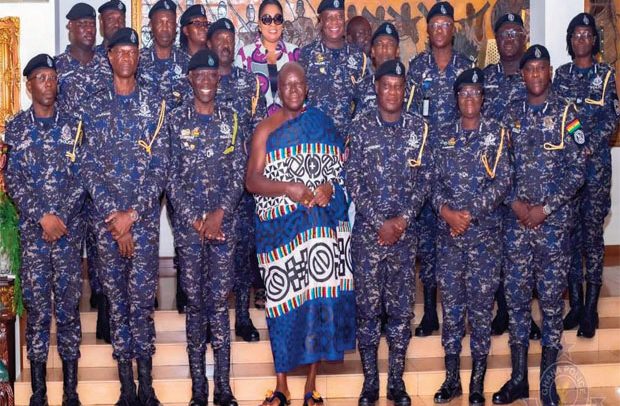
Asantehene Otumfuo Osei Tutu II has called on the Ghana Police Service to decisively confront indiscipline, ethical lapses and perceptions of political bias that continue to undermine public confidence in law enforcement, insisting that integrity remains the foundation of public order and national peace.
Delivering a firm address during his historic visit to the headquarters of the Ghana Police Service in Accra, Otumfuo urged the Inspector-General of Police (IGP), Christian Tetteh Yohunu and the police leadership to “seriously tackle issues affecting police integrity and public trust,” warning that misconduct by men in uniform dishonours both the badge and the national coat of arms they bear.
“Whatever compromises the integrity of the police dishonours the uniform,” the Asantehene said, stressing that when values collapse within the disciplined services, the moral authority of society itself is weakened.
The visit, the first by a reigning Asantehene to what he described as the “engine room” or “heartbeat” of the Police Service, was marked by a ceremonial guard of honour, a parade by female officers and performances by the Ghana Police Band.
Otumfuo was received by the IGP, members of the Police Management Board, traditional rulers and retired senior officers, including Commissioner of Police Kofi Boakye, popularly known as Commander One.
While the colourful ceremony reflected mutual respect, the Asantehene made it clear the occasion was not a routine courtesy call.“This is not a mere ceremonial visit. It is a landmark moment where two ancient responsibilities meet — the guardianship of values and the enforcement of law,” he said.
Otumfuo commended the Ghana Police Service for decades of sacrifice and professionalism, crediting officers for Ghana’s reputation as an oasis of peace in a turbulent region. He paid tribute to officers who endure difficult conditions guarding highways, remote communities and urban centres while citizens sleep in safety. However, he cautioned that appreciation must not silence hard truths.
The Asantehene acknowledged persistent public disquiet over incidents of misconduct, warning that such behaviour creates justification for indiscipline across society. “It is puzzling when Ghanaians see men in uniform act publicly in ways that compromise the integrity of the service,” he noted.
In one of the most pointed sections of his address, Otumfuo urged the Police Service to remain visibly politically neutral. While recognising that the Service is constitutionally loyal to the government of the day, he warned against any perception of alignment with partisan interests.
“There must be a line drawn between the government and a political party,” he said, stressing that law enforcement must be pursued without fear or favour, affection or ill will.
Placing policing within a broader historical and cultural framework, the Asantehene argued that long before modern law enforcement, Ghanaian societies relied on customs, values and communal restraint to maintain order.
“Custom was the first law. Culture was the first constitution,” he said, explaining that crime prevention begins in homes and communities long before police intervention becomes necessary.
He warned that no number of officers, regardless of discipline or equipment, can compensate for a society that has lost its moral compass.
Otumfuo, therefore, called for deliberate alignment between culture and law, proposing structured collaboration between traditional authorities and the Ghana Police Service to strengthen community policing nationwide.
Responding, Inspector-General of Police Christian Tetteh Yohunu described the Asantehene’s visit as unprecedented and transformative, saying it compels a fundamental rethink of policing philosophy in Ghana.
He noted that long before European-style policing, indigenous systems, particularly within the Asante Kingdom, ensured law, order and dispute resolution through customs respected and internalised by communities.
According to the IGP, colonial policing did not erase these systems, but blended with them, shaping the hybrid policing model Ghana practices today. “This visit challenges us to re-embrace indigenous knowledge systems and strengthen community-based, tradition-informed policing,” IGP Yohunu said.
The IGP disclosed that the Police Service will integrate cultural literacy, customary law and local governance systems into police training, orientation and re-orientation programmes to improve empathy, legitimacy and cooperation at the community level.
He emphasised that chiefs remain indispensable partners in addressing chieftaincy disputes, land conflicts and communal tensions that often strain formal policing capacity, citing Otumfuo’s mediation in the Dagbon chieftaincy crisis and peace efforts in Bawku as evidence of effective traditional intervention.
For more news, join The Chronicle Newspaper channel on WhatsApp: https://whatsapp.com/channel/0029VbBSs55E50UqNPvSOm2z
The post Otumfuo Advises Police To Build Public Trust appeared first on The Ghanaian Chronicle.
Read Full Story











Facebook
Twitter
Pinterest
Instagram
Google+
YouTube
LinkedIn
RSS