

By Gabriel Yeboah Ofori
Clearer ownership structures, credible credit reporting, and transparent recovery processes are key to making Ghana competitive.
Trust is the lifeblood of business. It is not just an abstract value rather it is a measurable factor that influences whether capital flows, goods are delivered, and contracts are honored.
In Ghana today, the question of trust in business transactions is becoming more urgent as opportunities expand through the African Continental Free Trade Area (AfCFTA), foreign direct investment inflows, and the growth of local enterprises.
While Ghana enjoys a reputation as one of Africa’s more stable and attractive markets, the business environment is not without risks. Credit defaults, opaque ownership structures, and weak due diligence practices often discourage investors and raise the cost of doing business.
As Ghana integrates more deeply into regional and global trade systems, the country’s ability to strengthen transparency and accountability in commerce will determine how much value it can capture.
The Rising Cost of Business Risk
Every investor, supplier, or financial institution weighs risk before committing resources. In Ghana, stories abound of international suppliers who shipped goods on credit to Ghanaian buyers, only to face delayed or unpaid invoices. Some investors have injected capital into businesses that appeared sound but later revealed hidden liabilities or governance weaknesses.
These incidents do not just hurt the individual companies involved rather they have a ripple effect. When defaults pile up, the perception of country risk rises, leading to higher financing costs for Ghanaian businesses across the board. Banks become more cautious in lending, foreign partners tighten their requirements, and credit insurers increase their premiums.
This cycle underscores a simple truth: trust deficits are expensive.
Why Business Due Diligence Is Now Essential
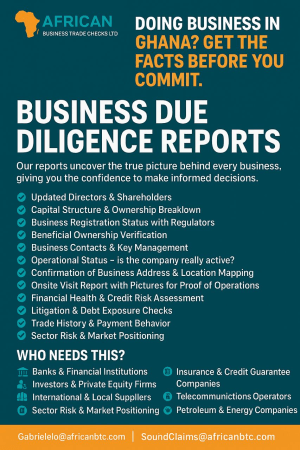
The antidote to uncertainty is information thus verified, reliable, and timely. Business due diligence provides the foundation for informed decision-making. By examining a company’s directors, shareholders, capital structure, compliance status, and operational history, due diligence transforms speculation into clarity.
In practical terms, due diligence helps answer questions that every serious partner should ask:
- Is the company legally registered and in good standing with regulators?
- Who ultimately controls the business, and do they have a credible track record?
- What is the financial and operational health of the company?
In Ghana, due diligence is still sometimes treated as optional, often skipped in the rush to close deals. But in a competitive market, businesses that can present verified, transparent profiles gain a distinct advantage. They attract not only financing on better terms but also long-term partnerships grounded in trust.
The Strategic Role of Credit Bureaus
Ghana’s credit reporting framework, regulated by the Bank of Ghana, has made significant progress in the last decade. By collecting and sharing borrower histories, credit bureaus allow lenders to make decisions based on facts rather than guesswork. This reduces defaults and encourages responsible borrowing.
Yet challenges remain. Data quality needs continuous improvement, especially from smaller financial institutions. Coverage of small and medium enterprises (SMEs), the backbone of Ghana’s economy is still limited. Many SMEs operate informally, leaving little trace in credit systems. Unless this gap is addressed, SMEs will remain excluded from affordable financing.
To align with international best practices, Ghana must continue reforming its credit reporting system, focusing on standardization, automation, and broader participation. When businesses know that their performance is being recorded and recognized, they are more likely to honor commitments, creating a virtuous cycle of trust.
Debt Recovery: Closing the Loop
Even with strong due diligence and credit systems, defaults will occur. What matters is how they are resolved. Transparent, efficient debt recovery processes ensure that businesses and investors can recover losses without resorting to costly disputes.
This is why international credit insurers are playing an increasingly important role in Ghana. Institutions such as Sinosure, Atradius, Credendo, Allianz Trade, and SACE provide protection to exporters and lenders who extend credit to Ghanaian firms. When defaults occur, structured recovery ensures that risks are absorbed in a fair, predictable way thus keeping doors open for future business rather than slamming them shut.
For Ghanaian firms, cooperating with recovery efforts is not just about settling obligations. It is about signaling to the world that Ghana’s business environment values responsibility and accountability.
The AfCFTA Opportunity and the Transparency Imperative
The African Continental Free Trade Area represents one of the boldest economic initiatives of our time. For Ghana, as host of the AfCFTA Secretariat, the stakes are particularly high. Increased trade across African borders could unlock billions in value for Ghanaian exporters, manufacturers, and service providers.
But AfCFTA will not deliver its full potential unless businesses across the continent trust each other. A Ghanaian exporter dealing with a buyer in Kenya, or a South African investor considering a joint venture in Accra, will ask the same questions: Is this partner credible? Can this deal be trusted?
Ghana has an opportunity to lead by example and show that robust due diligence, reliable credit reporting, and effective debt recovery can underpin cross-border trade. By building transparency into its own systems, Ghana strengthens its position as a trusted hub in the African trade network.
Beyond Systems: Tackling the Informality Challenge
One of the toughest challenges in Ghana’s business environment is the persistence of informality. Thousands of businesses operate outside formal registration, often with little to no financial records. While these businesses contribute significantly to employment and innovation, their lack of formal structures makes them invisible to lenders, investors, and regulators.
Efforts to formalize businesses must go beyond enforcement. They must provide incentives such as easier access to credit, reduced compliance costs for SMEs, and tax regimes that encourage gradual transition into the formal economy. Without tackling informality, Ghana’s credit and due diligence systems will continue to have blind spots, leaving both local and international partners exposed to hidden risks.
Digital Transformation as a Trust Enabler
Technology offers a way forward. With digital business registration, online verification portals, and integration between regulators and private sector databases, Ghana can make due diligence faster and cheaper. Mobile money and fintech platforms have already transformed payments, a similar leap is possible in trade and credit verification.
Imagine a future where a supplier in Germany can, within minutes, verify the operational status and creditworthiness of a Ghanaian business through a secure platform. That kind of transparency reduces hesitation, lowers risk premiums, and accelerates trade. Ghana should invest aggressively in digital infrastructure for business trust.
Why Businesses Must Take the Lead
It is tempting to view transparency as the job of regulators, but the private sector has just as much at stake. Every time a Ghanaian company defaults on obligations or hides critical information, it damages the reputation of all businesses in the market. Conversely, when companies embrace openness, they elevate Ghana’s credibility as a whole.
Forward-looking firms can differentiate themselves by voluntarily publishing key information, obtaining third-party due diligence reports, and maintaining robust governance systems. These actions are not just about compliance but they are competitive advantages in a world where trust is scarce but highly valued.
Building Investor Confidence in a Challenging Global Climate
The global business environment is uncertain, with rising interest rates, tighter credit conditions, and increased geopolitical tensions. For Ghana to continue attracting capital, it must stand out as a market where investors feel their risks are manageable. Transparent systems, clear legal frameworks, and reliable recovery processes can help Ghana punch above its weight, even in a cautious investment climate.
By demonstrating that Ghana takes trust seriously, the country can convert global uncertainty into an opportunity of positioning itself as a safe haven for credible trade and investment in Africa.
Building a Culture of Transparency
Reforms and systems alone are not enough. Trust must become part of Ghana’s business culture. This requires:
- Businesses embracing compliance, proper documentation, and transparent governance as assets rather than burdens.
- Regulators making registration, reporting, and data submission efficient, reducing barriers to compliance.
- Financial institutions and investors demanding due diligence as a standard requirement, not an optional extra.
A cultural shift toward transparency benefits everyone. Businesses gain credibility. Investors gain confidence. Regulators gain compliance. And the broader economy gains resilience.
Looking Ahead: From Trust Deficits to Trust Dividends
Ghana stands at a crossroads. The economy has the fundamentals to grow, but credibility will determine the pace and sustainability of that growth. If due diligence, credit reporting, and debt recovery systems are strengthened, Ghana can move from suffering the costs of trust deficits to enjoying the dividends of trust.
The dividends are tangible: cheaper financing, deeper investment, stronger trade relationships, and a more competitive economy. In the end, trust is not an abstract virtue rather it is a strategic asset and for Ghana, it may well be the most valuable asset of all.
Gabriel is the Founder & MD of African Business Trade Checks Ltd and Country Director of SoundClaims (Ghana). He brings more than 11 years of expertise in building robust credit reference bureaus, trade check systems, and debt recovery frameworks. His work focuses on advancing credit innovation, strengthening compliance, and shaping regulatory reforms across Africa. ( 233203748854, [email protected]
The post From risk to resilience: Building trust in the business ecosystem appeared first on The Business & Financial Times.
Read Full Story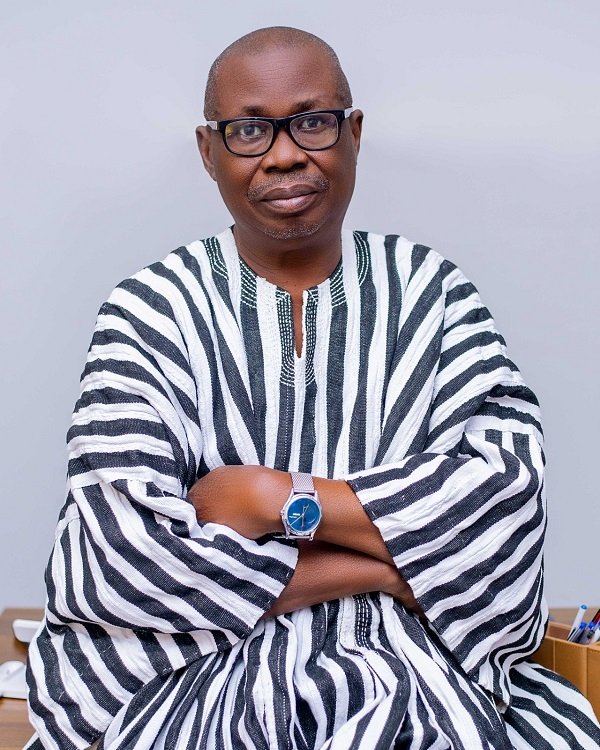






Facebook
Twitter
Pinterest
Instagram
Google+
YouTube
LinkedIn
RSS