


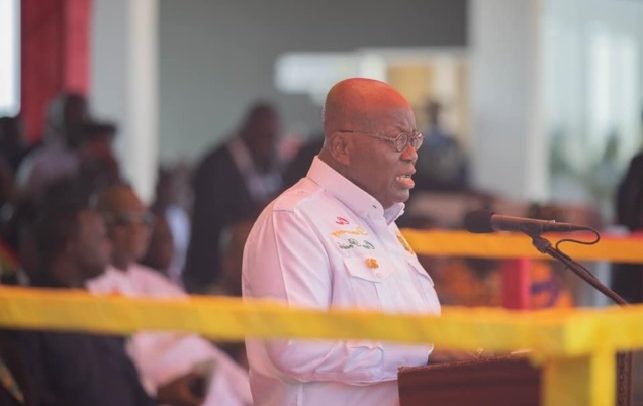
The President made the call when he delivered the keynote address, at the 60th anniversary commemoration ceremony of the bank held at the LA Palm beach hotel today August 18, 2018 under the theme; “Celebrating 60 Years of Central Banking in Ghana: Achievements, Challenges and Prospects”.
“The need to entrench reputation and credibility in the financial system is crucial. A weak banking system undermines growth, and, on this basis, the current weaknesses in our banking sector need to be addressed forcefully to minimize any adverse financial consequences to unsuspecting savers, and their spill-over effects on the economy. My understanding is that a road-map for addressing banking sector weaknesses is being implemented. I urge you, as the nation’s central bank, to remain committed to the process and to address the challenges confronting the banking sector. This will not only guarantee financial stability, but also promote greater confidence in that sector. Your most recent measures, in intervening decisively over the matters of UT Bank and Capital Bank, demonstrate your preparedness to act in a manner worthy of a responsible central bank, of a praiseworthy regulator. I am confident that you have the support of the nation” the President noted.
Partnership between the Bank and Government
President Akufo-Addo underscored that there is the need for a stronger partnership between the central bank and his government if the country is to achieve its desired fiscal policies.
“It is my firm view that, to sustain macroeconomic stability and rapid growth in a developing nation like ours, there must be partnership and co-operation between the central bank and government. The relationship between the Bank and the Government has been captured in the Bank of Ghana Act, 2002 (Act 612), as amended by Act 918 of 2016”.
The president also observed that “While the President appoints the Governor and his deputies as well as members of the Board of Directors, the Bank is guaranteed its operational independence in order to deliver on its multiple mandate. Full autonomy for the Bank, however, does not mean that the Bank’s monetary policies should be at variance with Government’s overall macroeconomic policies. With 60 years of experience behind us, I believe we should have learnt great lessons both from our own history and from the experiences of other countries about how this partnership should work. History has taught us well that monetary policy must complement fiscal policy to create an enabling macroeconomic environment to promote growth and development of the Ghanaian economy”.
The President noted “urge the Bank of Ghana to reflect soberly on its experiences, the good times and the hard times, take lessons from the challenging times, and focus on working to promote confidence in the economy, and instil discipline in the oversight responsibilities of the financial sector. I urge the Bank, and by extension the Ministry of Finance, to put in place policies that are both internally and externally consistent. Under my leadership and watch, I insist that there must be greater fiscal and monetary policy coordination to promote and sustain macroeconomic stability. This is the only way by which we will enable the private sector to flourish and create the needed jobs within the economy”.
Government’s Supportive role
The President on the issue of support stated that his government will do all it can to ensure that it gives the central bank all the backing t deserves to make their work fulfilling.
“The burden of maintaining stability is not that of the central bank alone. Government has a role to play. We are committed to the path of fiscal consolidation. We must do this so that the Bank of Ghana can concentrate on what it was set up to do. Persistent and excessive fiscal deficits get in the way of the Bank’s core mandate. To this end, we are committing by statute to ensure that the overall government fiscal deficit remains within a reasonable band of between 3-5 percent, beginning in 2018. We are also working hard to find a solution to the huge energy sector-related debt exposures that threaten the stability of the country’s banking system.
To offset the legacy debts in the energy sector, government will shortly issue a $2.5 billion energy bond. It will provide much needed liquidity to the banking sector, and also create space for increased investment in the sector by improving the balance sheets of companies such as VRA, GRIDCO and ECG. The bond will be collateralised with proceeds from the Energy Sector Levy.
Government will continue to pursue vigorously policies that would complement the Bank’s effort of bringing down the cost of borrowing for the benefit of households, and especially of micro, small and medium-scale enterprises, who provide most of the jobs. Government will, thus, continue to improve the supply of electricity in a bid to reduce the risks inherent in the economy, and lower the risk premium that feeds into cost of funds” he said.
The post Address banking sector challenges forcefully- Nana Addo appeared first on Ultimate FM.
President of the Republic, Nana Addo Dankwa Akufo-Addo has admonished authorities and staff of the Bank of Ghana (BoG) to employ all creative means and available remedies to address any challenge confronting the banking sector of the country. The President made the call when he delivered the keynote address, at the 60th anniversary commemoration ceremony […]
The post Address banking sector challenges forcefully- Nana Addo appeared first on Ultimate FM.
Read Full Story





Facebook
Twitter
Pinterest
Instagram
Google+
YouTube
LinkedIn
RSS