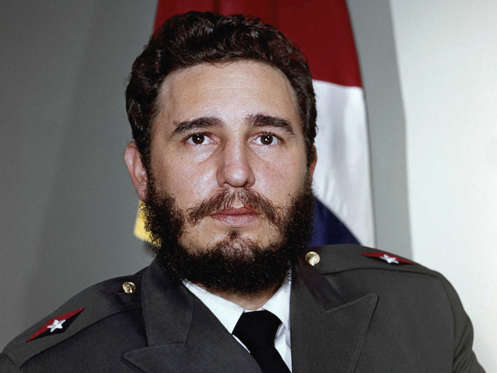
Fidel Castro has died at the age of 90, Cuban state television announced on Saturday, ending an era for the country and Latin America. The revolutionary icon, one of the world’s best-known and most controversial leaders, survived countless US assassination attempts and premature obituaries, but in the end proved mortal after suffering a long battle […]
Fidel Castro has died at the age of 90, Cuban state television announced on Saturday, ending an era for the country and Latin America.
The revolutionary icon, one of the world’s best-known and most controversial leaders, survived countless US assassination attempts and premature obituaries, but in the end proved mortal after suffering a long battle with illness.
The announcement was long expected, given the former president’s age and health problems, but when it came it was still a shock: the comandante – a figurehead for armed struggle across the developing world – was no more. It was news that friends and foes had long dreaded and yearned for respectively.
The father of communist Cuba, Fidel Castro, died on Nov. 25, 2016, at the age of 90. The controversial and divisive world figure received several international awards and is recognized as a champion of socialism, anti-imperialism, and humanitarianism. Let’s take a look at the life of the revolutionary who ruled Cuba for almost five decades.
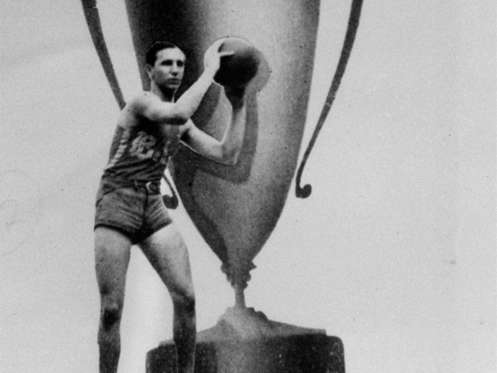
Castro was born in Cuba in 1926, the illegitimate son of Ángel Castro, a rich farmer. At school, he was an intelligent but not exceptional student — although his main passion was for sport, at which he excelled. But it was when he went to study law at the University of Havana that Castro began to develop his political awareness, becoming involved with a variety of left-wing activist groups. In 1947, he joined a military expedition to try and overthrow the right-wing dictator of the Dominican Republic but when that failed, he returned to Cuba. In 1948, Castro married Mirta Díaz Balart, who came from a wealthy Cuban family. One of the wedding gifts he received was $1,000 from Cuban general Fulgencio Batista, a friend of Balart’s family. (Pictured) Castro after he was chosen as the best athlete of Belen High School in 1945.
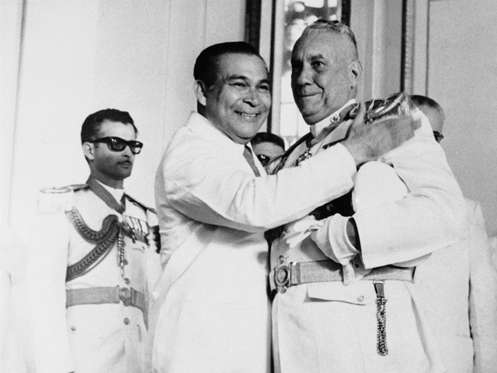
Castro was working as a lawyer in 1952 when Batista — who had already served once as a left-leaning president of Cuba — staged a military coup three months before the elections were due. Unlike his legitimate first term as president, the U.S.-backed Batista (C) ruled as a dictator in the interests of the wealthy, with both American business and American organized crime enriching themselves while ordinary Cubans became increasingly impoverished.
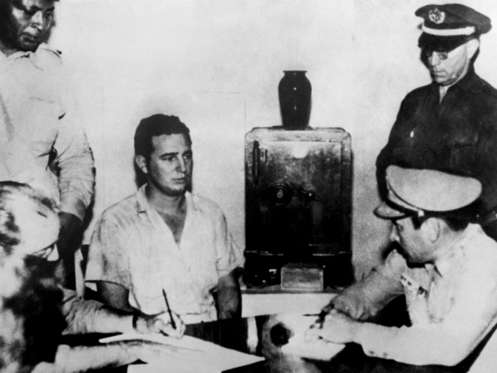
In response to the Batista coup, a number of revolutionary organisations in Cuba were formed with the intention of opposing the regime — one of which, known simply as “The Movement,” was formed by Castro. In 1953, Castro led a group of over 100 rebels — including his brother Raúl — in an attack on a military garrison, the Moncada Barracks. Despite careful planning, the attempt to start an uprising was a disaster as the rebels were heavily outnumbered, and were quickly forced to retreat, with many of them captured or killed. Castro retreated to the mountains but over the next few days, the remaining rebels were rounded up and either executed or, like Castro, put on trial. Castro is pictured on the left, giving his deposition to military and police chiefs at the Vivac in Santiago de Cuba in July 1953. On Oct. 16, Castro was sentenced to 15 years imprisonment; although in the end, he would serve less than two years. At his trial, he said: “Condemn me. It does not matter. History will absolve me.”
Despite being sentenced for 15 years, Castro was released in 1955 as the newly confident Batista regime — bolstered by support from the U.S. — believed the rebels to be no threat to them. During his time in jail, Castro and his wife began divorce proceedings after she began working for Batista’s Ministry of the Interior. A few months after his release, in July 1955, Fidel followed his brother Raúl to Mexico, where the latter introduced him to a young Argentinian doctor called Ernesto Guevara, commonly known as Che. Guevara was committed to helping spread revolutionary activities and fighting the U.S. influence across Latin America. (Pictured) Fidel (L) and Che are seen in jail in Mexico City after being arrested in June 1956, quite possibly the first picture of them together.
Guevara (R) and Castro (L) would become profoundly influential in each other’s lives, as the Argentinian joined Fidel in his fight against the Batista regime. In December 1956, a group of revolutionaries — including Fidel and Raúl Castro, and Che Guevara — traveled back to Cuba, where they set up a camp in the Sierra Maestra mountains, and began a grueling, years-long campaign of guerrilla warfare.
Throughout 1957, Castro and his allies led repeated attacks on military outposts of the Batista regime across the Sierra Maestra region while building support among locals and attracting new recruits from the cities. By 1958, the attacks had proven so successful that the Batista government withdrew its forces from the mountain area entirely, giving Castro’s rebels control of virtually all of Oriente Province. Seeing the tide turning against Batista, the U.S. withdrew its support for Batista and hoped to replace him with a right-wing, military-led regime better placed to thwart Castro. Out of allies, Batista resigned on the New Year’s Eve of 1958, and subsequently fled the country, taking a fortune estimated to be at $300 million with him.
After Batista’s resignation, the U.S.-backed military — led by General Eulogio Cantillo — attempted to take control of the country. But the massive swell of support behind Castro was too great. On Jan. 1, Castro supporters took to the streets of the capital Havana to celebrate Batista’s fall, burning casinos and other symbols of the old regime’s power (pictured). On Jan. 2, Guevara-led revolutionary forces entered Havana, while Castro’s forces took the second city of Santiago. A week later, on Jan. 8, Castro finally entered Havana to a hero’s welcome.
With the fall of the Batista regime and the arrest of General Cantillo, a liberal lawyer named Manuel Urrutia Lleó — who had defended rebels in trials established by the Batista regime, and had been strongly backed by Castro — was declared president. But Castro and Urrutia quickly fell out; Urrutia and his prime minister José Miró wanted to establish democratic elections and restore the rule of law. Castro, however, opposed elections and was quick to oversee the execution of former Batista regime officials without proper trials. In mid-February, Miró unexpectedly resigned — leading to Castro being sworn in as prime minister, and leaving Urrutia isolated. A few months later, in July, Castro briefly resigned as prime minister and denounced Urrutia — who, out of allies, offered his resignation. Castro then resumed his duties as prime minister having appointed a replacement president of his own choosing.
Unlike Che Guevara and his brother Raúl, during his time as a revolutionary, Castro had always refused to identify himself as a communist, in the hope of building a broader coalition. But once in power, he began a widespread program of nationalization of property and business, socialization of healthcare and collectivization of agriculture and other means of production — winning him widespread support among the country’s poor. Simultaneously, he also set about purging Cuban society of opponents — not just backers of the Batista regime, but moderates and liberals as well. Opposition newspapers were closed, a surveillance network (the Committees for the Defense of the Revolution) was established to report on counter-revolutionary activities, and many opponents of his rule were arrested and imprisoned. Other groups who Castro disliked were also targeted — notably homosexuals, who were imprisoned on a large scale. (Pictured) Castro signs the decree nationalizing all American-owned banks in Cuba in September 1960 as President Osvaldo Dorticos looks on.
In 1961, Castro officially announced that Cuba was a socialist state, and formally allied the country with the Soviet Union, which in return established new trade deals and provided arms. Castro embraced the Soviet Union partly in response to a growing trade war with the U.S.; when the Cuban government had nationalized the properties of the U.S. companies, the U.S. imposed a tight quota on its sugar imports from Cuba, something that could severely damage the island’s economy. Castro is pictured here greeting the Soviet Premier Nikita Khrushchev at the UN General Assembly in New York, U.S., in September 1960. Over the following years, the U.S. trade restrictions were tightened to a full-on embargo, preventing any trade with and travel to Cuba on the part of Americans, and even attempting to prevent any firm that did business with Cuba also doing business with the U.S. Shortly before President Kennedy formalized the trade embargo in 1962, he reportedly asked that 1,000 Cuban cigars be bought for him for his future enjoyment.
In addition to the trade war, since 1960 the U.S. had been actively trying to undermine and disrupt the new Cuban regime. This culminated in the disastrous April 1961 attempt by CIA-organised Cuban exiles to invade the island. On April 17, 1961, around 1,400 Cuban exiles, under the command of U.S. soldiers and CIA operatives, landed at the Bay of Pigs on Cuba’s south coast. But Castro’s government — which knew they were coming thanks to its intelligence network — easily defeated the invaders after three days of fighting. Castro himself was present at the battleground to oversee the military operations (pictured). The botched invasion was a huge embarrassment to the new Kennedy administration.
Following the Bay of Pigs invasion attempt, Castro moved to strengthen Cuba’s military ties to the Soviet Union — including secretly agreeing to build bases that would hold Soviet R-12 MRBM nuclear missiles, enabling the Soviets to target the U.S. in the same way American nuclear bases in Europe could target the USSR. In October 1962, a U.S. surveillance flight obtained photographic proof of the missile bases (pictured), sparking an international incident that brought the world the closest it has ever been to a nuclear war. After 13 incredibly tense days in which it looked likely that the U.S. and the U.S.S.R. would go to war, the stand-off was resolved when Soviet Premier Khrushchev agreed to dismantle the Cuban bases and withdraw its missiles. In return, the U.S. secretly agreed to do the same with its Italian and Turkish missile bases, and publicly pledged never to invade Cuba.
Since before the Bay of Pigs incident and for many years following it, in addition to invasion attempts, the CIA had repeatedly plotted to assassinate Castro — at least eight separate plots are known of, while Cuban sources estimate they made hundreds of attempts. Notoriously, one of the reported assassination methods supposedly would have involved an exploding cigar — although it’s not clear if this was ever seriously considered by the agency. What is known that several real plots did involve attempts to poison Castro, including one that recruited his ex-lover and another ongoing collaboration between the CIA and American gangsters from Al Capone’s former criminal gang. Needless to say, all the assassination attempts failed.
With Cuba sat in the middle of the Cold War’s stand-off between the U.S. and the U.S.S.R., Castro continued to rule for decades with little change. Cuba was cut off from much of the world by the U.S. embargo, severely limiting the civil rights of its citizens at home but supported economically thanks to trade with the Soviet Union. During this time, Castro supported other Marxist revolutionary movements across both Latin America and parts of Africa, such as Angola and Ethiopia — the former winning him the admiration of the then-jailed Nelson Mandela (L).
Cuba’s decades of relative — if tense — stability started to change at the end of the 1980s, as Castro grew disillusioned with Mikhail Gorbachev’s (R) reformist leadership of the Soviet Union and the decline of communism across Eastern Europe. In 1991, the collapse of the Soviet Union proved a devastating blow for Castro’s Cuba. Losing its major trading partner, responsible for 80 percent of its imports and exports, while still being under economic embargo from its superpower neighbor, saw the country plunged into an economic crisis.
The economic crisis, which had started in 1989, was exacerbated following the collapse of the Soviet Union. By 1992, the country’s GDP had shrunk by over 40%. Castro declared sweeping austerity measures known as the ‘Special Period in Time of Peace,’ closing all non-essential factories, rationing petrol and electricity and even using oxen to replace tractors on some farms. In 1994, Castro lifted restrictions on Cubans wishing to leave the country. The number of Cubans fleeing the country to seek refuge in the U.S., often on ramshackle rafts, grew significantly — around 30,000 made for the Florida coast. Faced with a wave of immigration, the U.S. Government of Bill Clinton stopped accepting the refugees, returning them to Guantanamo Bay, the U.S. naval base in Cuba. (Pictured) Cuban refugees stranded in the open sea halfway between Key West and Cuba in August 1994.
In 2001, the category 4 Hurricane Michelle struck Cuba. Thanks to an efficient evacuation process, only four people died but it caused an estimated US $1.8 billion of damage, severely hurting the country’s recovering-but-still-fragile economy. Castro is seen here as he inspects a citrus grove damaged by the hurricane. Although Castro refused the offer of aid from the U.S., he did agree to a one-off purchase of food from the latter, the first shipment of food since the embargo was imposed.
In 2001, Castro fainted in public while in the middle of giving a seven-hour-long speech in the hot sun (above). It sparked rumors about the leader’s failing health and speculation about who would succeed him if he became too ill to govern.
At the end of July 2006, after undergoing a major surgery, Castro officially handed over his presidential duties to his brother Raúl (R), marking the end of over 45 years as Cuba’s de facto leader, both as prime minister and president (although he retained his official position). Over the following years, he was rarely seen in public, and rumors about his ill health continued to circulate.
Almost two years after handing over his duties, in February 2008, Castro officially retired as Cuban president, with Raúl taking over the role — although he remained as the leader of the Communist Party until 2011. In his retirement, and with his health apparently improved, Castro remained active in Cuban political life — writing a weekly column for the official Communist Party newspaper Granma and giving interviews with foreign journalists. He also spoke of some of the mistakes and regrets over his decades of rule — admitting economic blunders during the “special period,” and (among other things) describing his regime’s persecution of homosexuals as a “great injustice” for which he took responsibility.
Castro’s influence can still be seen across the island, including in the many pictures and murals of him still publicly displayed. In December 2014, U.S. President Barack Obama announced that the U.S. would restore diplomatic relations with Cuba, ending 50 years of hostility. Rumors had again begun to swirl about the former Cuban leader’s health as he hadn’t appeared in public since January. In March 2016, Obama and his family made a historic trip to the island nation, though there was no meeting between the two.
On Nov. 25, Raúl announced Castro’s death to the public and said: “The commander in chief of the Cuban revolution died at 22:29 hours this evening.” Before his 90th birthday in August, he had told his supporters that he didn’t expect to live long.
23/23 SLIDES
The Communist party and state apparatus has prepared for this moment since July 2006 when Castro underwent emergency intestinal surgery and ceded power to his brother, Raúl, who remains in charge.
Fidel wrote occasional columns for the party paper, Granma, and made very occasional public appearances – most recently at the 2016 Communist party congress – but otherwise remained invisible.
Confirmation of his death will trigger celebrations in Miami, the centre of Cuba’s exile community, and mourning among leftwing admirers around the world. For many Cubans on the island who grew up in his shadow, simultaneously respecting and resenting him, it will be a moment of profound ambivalence.
One thing all could agree on was that this extraordinary figure left his mark on history.
More than half a century ago, his guerrilla army of “bearded ones” replaced Fulgencio Batista’s corrupt dictatorship with communist rule that challenged the US and turned the island into a cold-war crucible.
The US had long counted on Castro’s mortality as a “biological solution” to communism in the Caribbean but, since officially succeeding his brother in 2008, Raúl has cemented his own authority while overseeing cautious economic reforms, and agreeing the momentous deal to restore diplomatic relations between Cuba and the US in late 2014, ending more than five decades of hostility.
By Raúl’s own admission, however, Fidel is irreplaceable. By force of charisma, intellect and political cunning the lawyer-turned-guerrilla embodied the revolution. Long before his passing, however, Cubans had started to move on, with increased migration to the US and an explosion of small private businesses.
It’s experience vs. loyalty with Trump’s State pick
Apparent in-fighting amongst Republicans over President-elect Donald Trump’s secretary of state pick spills into social media. Jonah Green reports.
Reuters
2016 White House Christmas tree arrives
First Lady Michelle Obama welcomes the 2016 White House Christmas tree for her last time. Rough Cut (no reporter narration).
Reuters
Heartbreaking scene as baby elephant tries to ‘wake up’ dying mother
Video reportedly shows a young and distressed elephant calf in India’s northeastern Assam state standing at its mothers side after the two fell into a construction ditch, leaving her unconscious and possibly dead. Mana Rabiee report.
His greatest legacy is free healthcare and education, which have given Cuba some of the region’s best human development statistics. But he is also responsible for the central planning blunders and stifling government controls that – along with the US embargo – have strangled the economy, leaving most Cubans scrabbling for decent food and desperate for better living standards.
The man who famously declared “history will absolve me” leaves a divided legacy. Older Cubans who remember brutal times under Batista tend to emphasise the revolution’s accomplishments. Younger Cubans are more likely to rail against gerontocracy, repression and lost opportunity. But even they refer to Castro by the more intimate name of Fidel.
Since largely vanishing from public view he has been a spectral presence, occasionally surfacing in what became a trademark tracksuit, to urge faith in the revolution. It was a long goodbye which accustomed Cubans to his mortality.
Exiles in Florida, the heart of the diaspora which fled communist rule, are expected to celebrate. Previous false reports of Castro’s death triggered cavalcades of cheering, flag-waving revellers.
Latin America’s leftist leaders, in contrast, will mourn the passing of a figure who was perceived less as a communist and more as a nationalist symbol of regional pride and defiance against the gringo superpower. The funeral is expected to attract numerous foreign heads of state, intellectuals and artists.





Reuters
 2016 White House Christmas tree arrivesFirst Lady Michelle Obama welcomes the 2016 White House Christmas tree for her last time. Rough Cut (no reporter narration).









Facebook
Twitter
Pinterest
Instagram
Google+
YouTube
LinkedIn
RSS