
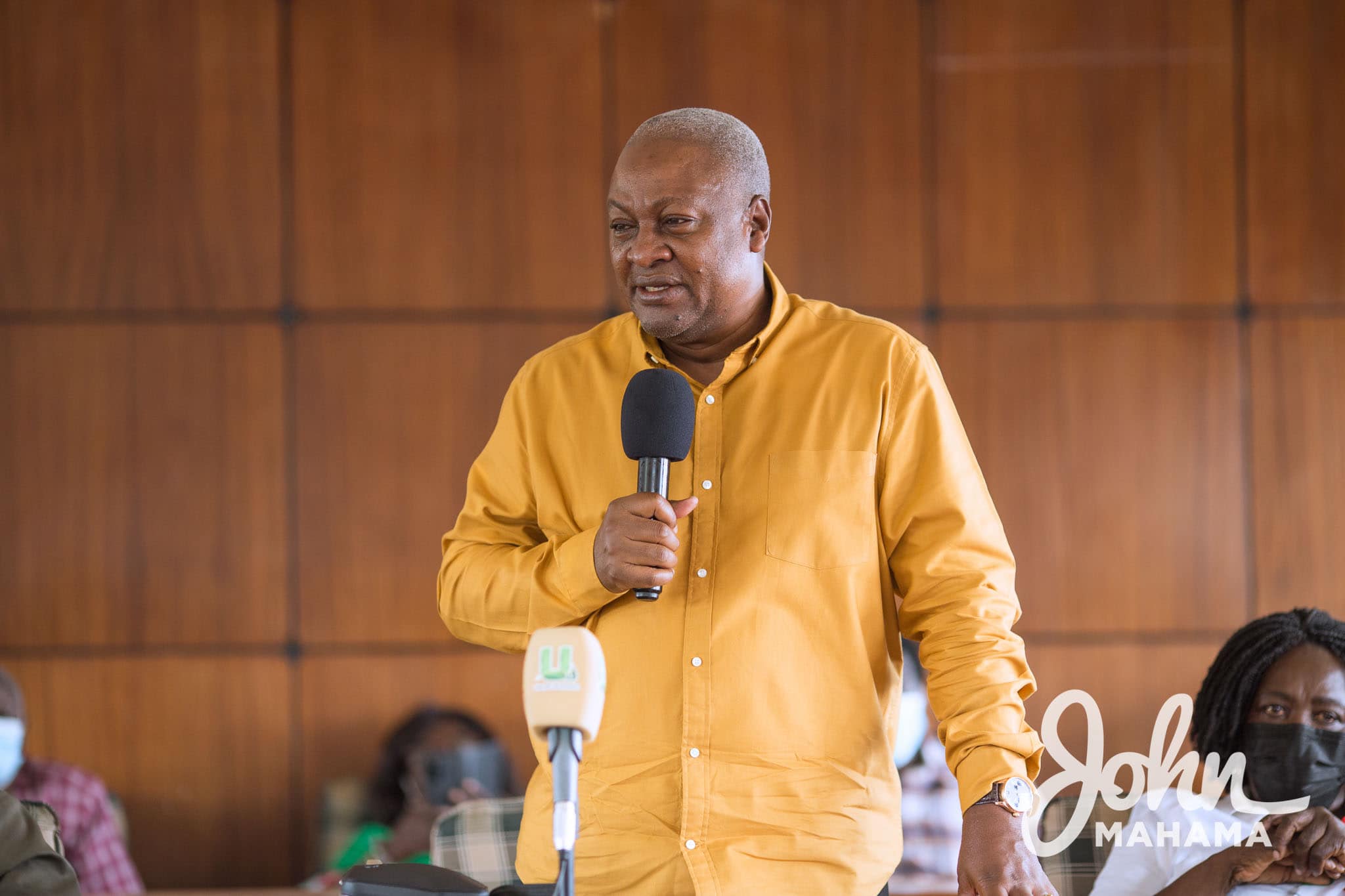

A private legal practitioner, Justice Abdulai has rendered an unqualified apology to former President John Mahama after the latter said Mahama cannot advise him on the law.
Mahama had earlier described the 7-0 unanimous decision of the apex court that presiding deputy speakers had the right to vote as “regrettable” and I look forward to the applicant applying for a review of this ruling.
Reacting to Mahama's comment, Abdulai in an interview on Accra FM on Thursday, March 17, 2022, said The former president cannot advise me on the law because he is not a lawyer.
I respect him as a former president but he cannot advise me on matters of the law, he said.
But Abdulai speaking on Joy News on Saturday, March 19, 2022, denied the claims.
He said: I'll never disrespect former President Mahama so I’ll never use any derogatory words against him, not under any circumstance.
He said his statement was taken out of context.
There have been rumours that I had snubbed President Mahama and I had even insulted and disrespected him. Some of these made it to the front pages of newspapers but these claims are untrue.
I wouldn't want to justify it by explaining it so I’ll rather render an unqualified apology to him. He’s a person I respect so much, he stated.
Abdulai petitions
Abdulai petitioned the court to declare as unconstitutional, First Deputy Speaker, Joseph Osei-Owusu's action of counting himself as one of the MPs on the floor while presiding over the proceedings of the House in relation to the formation of a quorum for the passage of the 2022 budget, which had earlier been rejected by the minority side.
He was of the view that once a Deputy Speaker, who is an MP, presides in the stead of the Speaker, he loses his right to vote.
Supreme Court rules
In a unanimous decision on Wednesday, 9 March 2022, however, the seven-member bench, presided over by Justice Jones Dotse, held that upon a true and proper interpretation of Article 103 and 104 of the 1992 Constitution, a Deputy Speaker, who is a Member of Parliament does not lose his right to take part in decision-making in parliament.
Justice Abdulai subsequent to the November 30, 2021 clash between Speaker Bagbin and his First Deputy after the latter overturned an earlier vote of the House rejecting the government’s 2022 budget invited the Supreme Court to pronounce as unconstitutional, Deputy Speaker, Joseph Osei Owusu's action of counting himself for a quorum.
He argued in the context of articles 102 and 104 of the 1992 Constitution that the Deputy Speaker was not permitted to count himself for a quorum, since he had neither an original nor a casting vote as Speaker presiding.
The Supreme Court struck out the standing order 109(3) which says a Deputy Speaker or any other member presiding shall not retain his original vote while presiding.
It furthered that the Deputy Speaker can be counted during the quorum for decision making according to article 104(1).
Lawyer Abdulai reacts after ruling
Speaking to the media on the ruling on Saturday, March 12, 2022, Abdulai said: This issue about the Deputy Speaker and the substantive Speaker being one and the same is something that I thought the Supreme Court should have made a firm pronouncement on.
The Constitution says that whoever occupies a position – whether acting or deputy – has the same powers and authorities as to the substantive one. The Standing Orders reaffirm this same position that the Deputy Speaker is the same or occupies the same position or function as the Speaker, he argued.
Because of this difficulty, I expected a firm pronouncement on those matters by the Supreme Court to put a finality to that part of it. A firm pronouncement would have put some level of clarity and finality to the disagreements that are presently ongoing, he noted.
He said: In their own judgment, [Justices] felt, 'probably it wasn't borne out of the reliefs that I was seeking', so, they refused to grant it. That's fair and part of the legal processes.
Read Full Story






Facebook
Twitter
Pinterest
Instagram
Google+
YouTube
LinkedIn
RSS