


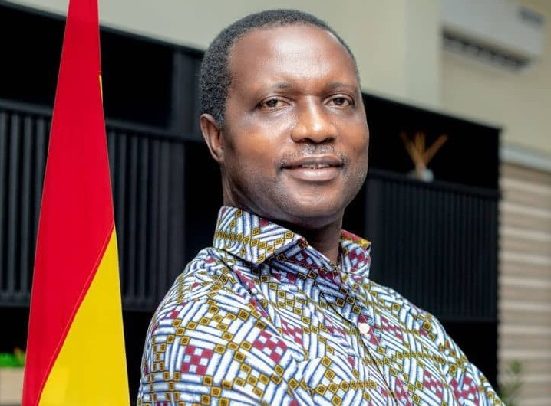
Dr Nana Ato Arthur,Head of Local Government Service.
Dr Nana Ato Arthur, Head of Local Government Service has urged Ghanaians to support the processes leading to the election of metropolitan, municipal and district chief executives (MMDCEs) by the year 2021.
He said the election of MMDCEs would promote local democracy by affording local people the opportunity to choose their own leaders.
He said it would also give them security of tenure and make them more accountable to their people
Dr Nana Ato Arthur made the call in his presentation at the just ended 70th Annual New Year School and Conference at the University of Ghana.
Speaking on the topic, ’Thirty Years of Decentralisation: Prospects and Challenges’, Dr Nana Ato Arthur citing from Agrawal and Ribot, 1999 said: “Decentralisation is an action by which the central administration formally cedes power to actors and institutions at lower level in a political administrative and territorial hierarchy.”
Dr Nana Ato Arthur said this means the transfer of power and responsibility from the centre to the sub-national level.
“And in Ghana when you talk about sub-national level, you’re referring to the regional coordinating council and the MMDAs. We are today talking about 30 years of decentralisation; we are referring to the PNDC law 207, that brought this current system of decentralisation into being, from 1998,” he said.
“But I want to argue that decentralisation has been with us for a very long time, in fact it is older than Ghana except that our form of decentralisation like many other countries in Africa has assumed what researchers call a pendulum model.”
Dr Nana Ato Arthur gave historic overview of decentralisation from Osagyefo Dr Kwame Nkrumah’s era up to the passage of PNDC Law 207, which was enacted to give legal backing to decentralisation.
“It is now a generation, so it is good that we are taking stock of the 30 years of decentralisation that we have accepted as Ghana’s tool for development,” he said.
With regards to major challenges of decentralisation, Dr Nana Ato Arthur said: “The Assemblies that are seen to be non-partisan, for me it is just theoretical. Are the assemblies non-partisan?” he questioned.
“Let us wait when the President appoints a district chief executive (DCE), and during the confirmation of a presiding member; that is where we see whether assemblies are partisan or non-partisan?”
Citing findings from a research conducted from his own constituency, Komenda Edina Eguafo Abirem (KEEA) in the Central Region, he said the statistics show that the assemblies were already partisan.
“There is a research in KEEA, my own backyard, on party affiliation of KEEA assembly elected members since 1998. The assembly that is supposed to be non-partisan; so how did we get to know that this number was New Patriotic Party (NPP); this number was National Democratic Congress (NDC) and then Convention People’s Party (CPP) and the Progressive People’s Party (PPP)?”
He said according to the research findings, in 1998; of the 36 assembly members, 22 belong to NDC, 10 NPP, and four PPP.
The 70th Annual New Year School and Conference, was on the theme: ‘Building strong institutions for democratic consolidation in Ghana’.
It was organised by the School of Continuing and Distance Education of the College of Education, University of Ghana, in collaboration with the Ministry of Local Government and Rural Development.
GNA
Read Full Story







Facebook
Twitter
Pinterest
Instagram
Google+
YouTube
LinkedIn
RSS