


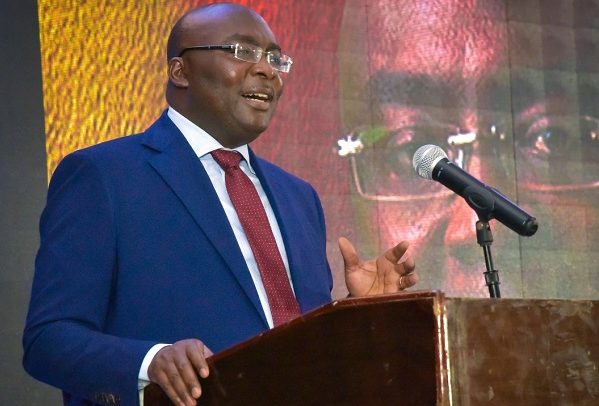
Accra, July 30, GNA - The Vice-President, Dr Mahamudu Bawumia, on Tuesday, commissioned three facilities at the Ghana Atomic Energy Commission (GAEC) in Accra, to enhance training, research, health and development.
The three facilities are the Low-Enriched-Uranium (LEU) Core Research Reactor; the International Miniature Neutron Source Reactor Training Facility; and the Laboratory Building for the Radiological and Medical Sciences Research Institute.
Dr Bawumia said the commissioning of these three facilities signified the country’s progress so far and demonstrated the commitment of the government to support the uses of Nuclear Science and Technology in areas such as Health, Agriculture and Industry for sustainable development.
He congratulated GAEC for its contribution towards national development, citing the efforts of the Commission in the establishment of the two Radiotherapy Centres at Korle-Bu and Komfo Anokye Teaching Hospitals, established for the treatment of cancer.
Dr Bawumia explained that, the Miniature Neutron Source Reactor (MNSR), which was a low power commercial type, designed with a maximum power of 30 Kilowatts, was acquired under a tripartite agreement between Ghana, China and the IAEA in December 1994.
He said the facility has since been used primarily for research, education and training, and after operating for 23 years, under strict safety conditions, there was the need to change the fuel from High-Enriched Uranium (HEU) to LEU, because the former could become a potential source material for nuclear weapons.
He said the threat of terrorism legitimises this concern and the solution worldwide, underpinned by the principles of non-proliferation, was to convert all highly enriched uranium-fuelled research reactors to low enriched uranium-fuelled ones.
The successful conversion was completed by Ghanaian scientists in collaboration with Scientists and Experts from the Argonne National Laboratory (ANL) and Idaho National Laboratory (INL) of the United States Department of Energy (US DoE), the International Atomic Energy Agency (IAEA) and China Institute of Atomic Energy in August 2017.
Dr Bawumia said the total expenditure of the conversion was USD 22,000,000.00, with over 90 per cent of the amount provided by the US Government and IAEA, whilst Ghana Government provided the needed security, making Ghana the first country, outside China to successfully complete the conversion of this reactor type, a feat which earned it an outstanding performance award from the National Nuclear Security Administration, Department of Energy of the United States of America.
He said the new fuel was expected to last for the next 40 years, with the International Miniature Neutron Source Reactor serving as an additional resource to support the needed basic training of the required manpower for Ghana’s Nuclear Power Programme (NPP), and other Scientists and Engineers from various countries.
He acknowledged the progress made by the Ghana Nuclear Power Programme Organization (GNPPO) since its establishment in 2012, to see to the development of nuclear power for electricity purposes, saying government awaits a Programme Comprehensive Report to be submitted this year, to set the stage for the government to make a clear knowledgeable commitment to Ghana's first Nuclear Power Plant (NPP).
The Vice President said the Government as part of its commitment to the NPP, has released an amount of US$300,000 to support the site selection process for the NPP, in addition to Cabinet’s approval of the setting up of an Organization to oversee the construction and Operation of the Plant.
He also commended GAEC for its input in the construction of the new Radiological and Medical Sciences Research Institute laboratory building project, at a total cost of GH? 534,413.00, with GH?457,375.00 as Government of Ghana (GoG) funding through the Ministry of Environment, Science, Technology and Innovation; and the remaining GH?77, 037.00 provided from GAEC’s Internally Generated Funds.
He said the new Institute, would research in areas such as radiation medicine, cancer research, medical imaging, diagnostic molecular biology and nutrition, and aimed at becoming a leading medical research institution in Ghana and Africa, employing nuclear techniques to promote general human health.
“We believe it will also help our quest to achieve some of the sustainable development goals, specifically, Good Health and Well-being, as well as Quality Education, which will transform our world,” he said.
He acknowledged the contribution of the Sector Minister, Management and Board of GAEC for their dedication and passion for the promotion of nuclear science and technology for sustainable development, and also the IAEA for the sustained support in capacity-building initiatives through technical training and fellowships.
The Vice President said it was re-assuring that Ghana had been a state party to the Nuclear Non-Proliferation Treaty (NPT) since 1970, and has signed and ratified the Comprehensive Nuclear Test-Ban Treaty, as well as the African Nuclear-Weapon-free-zone Treaty, saying that, the country was currently one of the 125 countries to sign the Joint statement on the Humanitarian Consequences of Nuclear Weapons.
Professor Benjamin Jabez Nyarko, the Director-General of the Ghana Atomic Energy Commission, said the reactor has helped in training a number of personnel in nuclear engineering, most of whom were now playing critical roles in the country’s nuclear power infrastructure development programme.
He however said, in line with government’s desires to add nuclear power to the country’s energy mix in the shortest possible time, it was imperative that a number of engineers and scientists were employed and trained, as the IAEA considered the need for competent well-trained staff, a critical nuclear safety concern.
Prof. Nyarko appealed to the President, to upgrade the Graduate School of Nuclear and Allied Sciences of the University of Ghana, to a Technical University to offer undergraduate programmes as well as hands-on-training module opportunities, to handle the projected increase in the tertiary education sector due to the introduction of the Free Secondary Education policy.
Read Full Story









Facebook
Twitter
Pinterest
Instagram
Google+
YouTube
LinkedIn
RSS