


“Does this post contain hate speech?”
That is the message that thousands of Facebook users have reported seeing on their news feeds.
It seems to be only US-based users that can see the question, which is appearing under every post on their Facebook page.
While some have criticised the social media giant for the move, others are calling it a bug and pointing out the more unusual places where they have seen it appear.
A Facebook spokesperson said they were unable to comment at this time.

If users click “yes” to respond that the post does contain hate speech, they are presented with four options for feedback.
These options are “hate speech”, “test p1”, “test p2” and “test p3”, prompting some people to suggest that the form “clearly wasn’t supposed” to appear on Facebook in its current form.
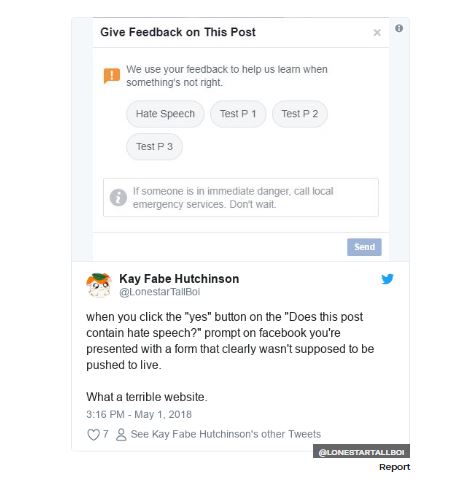
Yet the hate speech button was criticised as suppression by some, with American writer Matt Walsh calling it an intentional move by Facebook to remove “conservative content”.
This is in light of accusations from Republican congressman Steve Scalise that Facebook’s algorithm was discriminating against conservative news and content in favour of liberal posts.
And Lebanese-American journalist Brigitte Gabriel labelled it an attempt by Facebook to “censor” her account.
But as others noticed the button appearing on all of the posts in their timeline, people began to share the funniest place they had seen the button appear.
Such places include posts about local churches, articles about Donald Trump, and even pictures which show the weather forecast.
And Washington Post journalist Gene Park shared this suggestion that a photo of a puppy might be somehow hateful.
This comes as Facebook hosts its biggest event ever, with 5,000 developers flying in from around the world for the F8 developer conference on May 1-2.
This prompted social media journalist Matt Navarra to joke that even Facebook creator Mark Zuckerberg was not exempt from the hate speech button.
The post Facebook: ‘Hate speech button’ causes confusion appeared first on Citi Newsroom.
Read Full Story






Facebook
Twitter
Pinterest
Instagram
Google+
YouTube
LinkedIn
RSS