
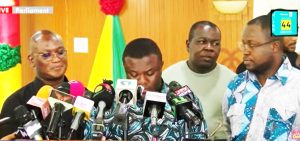

The Minority in Parliament has mounted a fierce critique of government’s handling of the ongoing power crisis, insisting that accountability must extend to the highest levels of leadership, including the Minister for Energy and Green Transition.
Addressing a news conference in Parliament yesterday, Deputy Ranking Member of the Energy Committee, Collins Adomako Mensah, rejected attempts by the government to attribute the recent nationwide outages to the April 23, 2026 fire outbreak at the Akosombo substation.
He argued that the crisis predates the incident and it is the result of prolonged policy failures and mismanagement.
“If any official is to face scrutiny, let that same scrutiny fall on the Energy Minister and on this president,” he declared, stressing that the current challenges in the power sector cannot be reduced to a single event.
According to him, Ghanaians had already been enduring persistent and unannounced outages months before the Akosombo incident, describing the fire as “the latest and most dramatic symptom of a power sector left to decay.”
He maintained that throughout April 2026, the Electricity Company of Ghana (ECG) had issued multiple emergency and maintenance schedules, while communities across the country experienced prolonged blackouts that disrupted businesses and daily life.
“Communities were living in darkness not for hours, but for days. Industries were haemorrhaging losses. Cold stores were warming, and hospitals were straining on generators,” he said.
Mr Adomako Mensah, who is also the Member of Parliament for AfigyaKwabre North, further accused the government of attempting to “rewrite history” by presenting the Akosombo disruption as the primary cause of the crisis.
“He insisted that the root of the problem lies in what he described as 14 months of “policy failure, institutional neglect, and abandonment of a working recovery plan.”
Central to his argument was the Energy Sector Recovery Programme (ESRP), which he said was inherited from the previous administration as a comprehensive framework to stabilise the sector financially and operationally.
The Minority claims the programme, developed with international partners, contained clear timelines and measures to address revenue shortfalls, infrastructure deficits and obligations to Independent Power Producers (IPPs).
Instead, he alleged, the current administration delayed and diluted the programme, worsening the financial condition of the sector.
“The crisis has never been about generation capacity. Ghana has over 5,200 megawatts installed capacity against a peak demand of about 4,300 megawatts. The problem has always been financial, managerial and infrastructural failure,” he said.
He also dismissed recent actions by government, including leadership changes within key power sector institutions, as cosmetic measures that do not address the underlying issues.
“Suspending officials and reshuffling management may generate headlines, but it will not solve the problem,” he argued, adding that such steps amount to “political management of embarrassment.”
The Minority further raised concerns over outstanding debts within the sector, claiming that government owes over $500 million to IPPs and more than $200 million to fuel suppliers. They called for full disclosure of the sector’s financial position, particularly in relation to the controversial “dumsor levy.”
Mr. Adomako Mensah questioned the utilisation of proceeds from the levy, noting that no detailed report has been presented to Parliament or the public.
“How much has been collected? Where has the money gone? What projects have been funded?” he asked, demanding an independently verified account of all collections and expenditures.
The Minority called on government to urgently implement the ESRP, clear outstanding IPP obligations, and publish a credible, time-bound plan to resolve the crisis. They also demanded a nationwide infrastructure safety audit and immediate parliamentary briefing by the Energy Minister.
“The Minister must appear before Parliament and provide a clear account of the state of Ghana’s power sector, including generation capacity, financial obligations and a concrete plan to end the outages,” he said.
While acknowledging the need for investigations into the Akosombo fire, the Minority cautioned against using the probe as a substitute for addressing broader systemic failures.“Any investigation must be thorough and transparent, but it must not distract from the fundamental issues that have brought the sector to its knees,” he added.
The Minority has vowed to pursue the matter through all constitutional means, including parliamentary oversight and public accountability measures.
“We will not allow this government to extinguish accountability as easily as it has extinguished the lights of Ghana,” Mr. Adomako Mensah said.
For more news, join The Chronicle Newspaper channel on WhatsApp: https://whatsapp.com/channel/0029VbBSs55E50UqNPvSOm2z
The post Jinapor Should Not Be Spared! … Minority Tells Mahama As Dumsor Bites Ghanaians appeared first on The Ghanaian Chronicle.
Read Full Story




Facebook
Twitter
Pinterest
Instagram
Google+
YouTube
LinkedIn
RSS