


A strong case has been made for the reintroduction of a redesigned Electronic Transfer Levy (E-Levy), as Economists and tax experts warn that Ghana’s decision to abolish key taxes risks widening fiscal deficits and undermining long-term development.
The proposal emerged as a central theme at a high-level public lecture organised by the Centre for Policy Scrutiny (CPS) in Accra, where stakeholders examined the implications of scrapping the E-Levy, COVID-19 levy and betting tax under the theme: “Assessing the Abolishment of the E-Levy, COVID-19 Levy and the Betting Tax: Fiscal Impact and Equity Considerations.”
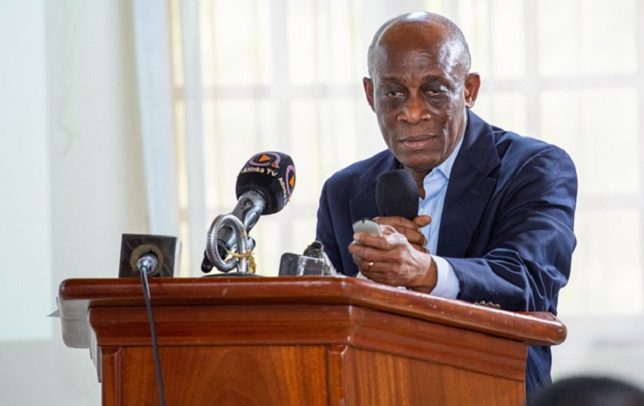
Delivering the keynote address, Isaac Danso Agyiri, a Lawyer, Chartered Accountant and Tax Specialist framed the debate not as a rejection of taxation, but as a question of design, efficiency and credibility.
He argued that Ghana’s fiscal challenges cannot be resolved through tax abolition alone, stressing that the country must instead refine its approach to domestic revenue mobilisation.
Reintroducing a Fairer Digital Tax
Mr. Agyiri’s lead recommendation was that government should revisit the E-Levy concept, but redesign it to address its regressive impact.
He explained that the previous structure disproportionately affected low-income earners because it taxed consumption, thereby taking a larger share of income from those who spend most of what they earn.
To correct this imbalance, he proposed raising the minimum threshold significantly to reflect current economic realities, while introducing caps on the maximum tax payable per transaction. He further suggested that revenue from such a tax should be transparently channelled into social and infrastructure projects to improve public trust.
His argument rests on a key empirical observation: despite initial resistance, mobile money transactions rebounded strongly after the introduction of the E-Levy, indicating that digital financial services in Ghana are resilient and capable of sustaining moderate taxation.
Fiscal Cost of Abolishing Taxes
A major concern raised at the forum was the scale of revenue losses resulting from the abolition of the three taxes. Estimates presented suggest that Ghana could forgo between GH¢14 billion and GH¢18 billion in the short term.
Mr. Agyiri emphasised that these figures are not merely abstract projections, but represent tangible development trade-offs.
He illustrated that revenue from the E-Levy alone could have financed critical infrastructure such as classrooms, hospitals and road networks, highlighting the opportunity cost of the policy decision.
The COVID-19 levy was identified as a relatively stable and predictable revenue source due to its integration into the VAT system, while the betting tax was widely regarded as ineffective, having generated only a fraction of its projected returns.
Beyond the immediate impact of the abolished taxes, the lecture exposed deeper structural issues within Ghana’s fiscal framework.
The country’s tax-to-GDP ratio remains around 16 percent, below both national targets and international benchmarks.
Mr Agyiri noted that while public debt has expanded rapidly over the years, revenue growth has lagged behind, creating a widening imbalance that threatens fiscal sustainability.
This, he argued, reflects a systemic reliance on borrowing rather than building a robust domestic revenue base.
He stressed that the introduction of the now-abolished taxes was originally intended to close this gap during a period marked by credit rating downgrades, loss of access to international capital markets and recourse to an IMF programme.
Policy Credibility and Forecasting Failures
Another critical issue discussed was the role of poor forecasting in undermining tax policy. The E-Levy, in particular, was criticised for its overly ambitious initial revenue targets, which failed to account for behavioural responses such as reduced usage and tax avoidance.
According to Mr Agyiri, such forecasting errors not only lead to underperformance, but also damage policy credibility and erode public trust.
He cautioned that frequent shifts in tax policy driven by political considerations rather than data—create uncertainty and weaken investor confidence.
The tension between economic necessity and political expediency also featured prominently in the discussions. Participants noted that while the abolished taxes were unpopular, their removal reflects a broader pattern in which fiscal decisions are influenced by electoral considerations.
Executive Director of CPS, Dr Adu Owusu Sarkodie, underscored this point, warning against what he described as a cycle of policy reversals.
He argued that taxes should be introduced and withdrawn based on rigorous modelling and empirical evidence, not political promises.
Dr Sarkodie explained that although taxation can have a short-term negative effect on economic activity, its overall impact depends on how effectively government utilises the revenue.
He noted that productive public spending can generate positive multiplier effects that offset the initial burden of taxation.
Untapped Revenue Potential
Dr. Sarkodie further highlighted that Ghana is not fully exploiting its revenue potential. He observed that tax revenue growth should ideally exceed GDP growth by a wider margin than currently recorded, yet the country continues to underperform.
He pointed to the digital economy as a critical frontier for future taxation, arguing that its rapid expansion presents an opportunity for sustainable revenue generation if properly harnessed.
In addition, he called for greater attention to the extractive sector, particularly gold, which accounts for a substantial share of Ghana’s exports.
Strengthening royalty regimes and reviewing existing agreements, he suggested, could significantly enhance government revenue.
GRA Reports 20% Revenue Growth, Calls for Stronger Tax Compliance
The Ghana Revenue Authority (GRA) has recorded GH¢33.7 billion in revenue for Q1, a 20% increase over the same period last year, according to Ms. Elsie Appau-Klu, speaking on behalf of Commissioner-General, Mr. Anthony Sarpong.
Despite this progress, only 19% of taxpayers pay income tax and 29% pay VAT, highlighting significant compliance gaps.
Appau-Klu stressed that greater efficiency in collecting existing taxes could reduce the need for new levies like the COVID-19 Levy.
She highlighted recent reforms, including the digital ITAS platform, the Modified Taxation Scheme for the informal sector, and a 24-hour WhatsApp response system, aimed at making tax compliance easier and more transparent.
She called on all Ghanaians to actively pay taxes, noting that collective engagement strengthens accountability and supports national development.
Equity considerations were also central to the debate, particularly regarding the burden of consumption taxes on low-income households. The consensus was that fairness in tax policy is essential for sustaining compliance and public support.
Participants emphasised that beyond tax design, the use of tax revenue plays a critical role in shaping public perception.
Transparent and accountable spending, they argued, is necessary to build trust and encourage voluntary compliance.
For more news, join The Chronicle Newspaper channel on WhatsApp: https://whatsapp.com/channel/0029VbBSs55E50UqNPvSOm2z
The post Introduce Modernised E-Levy To Rake In Revenue -CPS appeared first on The Ghanaian Chronicle.
Read Full Story










Facebook
Twitter
Pinterest
Instagram
Google+
YouTube
LinkedIn
RSS