


By Edwin S. Kwame KOGE
Public transportation is a foundational pillar of economic productivity, social inclusion, and urban functionality. Efficient transport systems move labour to centres of production, connect citizens to education and healthcare, and enable commerce at scale. In Ghana, however, public and quasi-public transport provision is under sustained strain. What commuters experience daily: long queues, stranded passengers, fare indiscipline, deteriorating vehicle quality, and emergency political interventions is not incidental. It is the cumulative outcome of structural weaknesses, policy incoherence, and institutional underperformance that have been allowed to persist over time.
Roles and realities
Ghana operates a hybrid transport model that combines state-owned operators, private unions, and informal services. On the public side, three government-backed operators dominate the landscape: the State Transport Company (STC), Metro Mass Transit Limited (MMTL), and the Ayalolo Bus Rapid Transit system. STC’s core mandate is inter-city and long-distance transport, linking regional capitals and major commercial corridors. MMTL operates a mixed model, providing both inter-city and intra-city services. Ayalolo, introduced as an urban mass transit intervention, focuses primarily on intra-city transport within Accra and its immediate environs.
In principle, this layered structure should ensure adequate coverage across distance, density, and income groups. In practice, it does not. All three state-backed operators are constrained by limited fleet sizes, inconsistent maintenance regimes, and persistent financial losses. Public audits, parliamentary oversight reports, and sustained media scrutiny have repeatedly pointed to governance lapses, weak asset management, and operational inefficiencies within these entities. The consequence is straightforward but significant: state operators do not deploy sufficient roadworthy buses to meet commuter demand on the routes they serve.
The role of GPRTU and private operators
The capacity gap created by the inefficiencies of state-owned operators is filled overwhelmingly by private transport providers, organised largely under the Ghana Private Road Transport Union (GPRTU). GPRTU-affiliated operators account for the majority of passenger movements across both inter-city and intra-city routes.
The Trotro system, informal in structure but extensive in reach, functions as Ghana’s primary mass transit mechanism for millions of commuters each day. Beyond trotros, the broader transport mix includes traditional taxis, app-based ride-hailing services, limited commuter rail services within Accra and Tema, and the expanding use of motorbikes, commonly referred to as Okada. Among these options, Trotros remain the most affordable and accessible for low and middle-income earners, making their reliability a matter of public policy rather than simple market preference.
Cost drivers and fare determination
Transport pricing in Ghana is shaped by identifiable and largely uncontested cost drivers. Fuel prices are the most immediate and visible variable, given the sector’s dependence on petroleum products. Spare parts costs are another critical factor, as most components are imported and therefore exposed to exchange rate volatility. Road conditions further compound costs, with deteriorating surfaces accelerating vehicle wear and increasing maintenance frequency. Contrary to popular perception, transport fares are not set arbitrarily by drivers or unions.
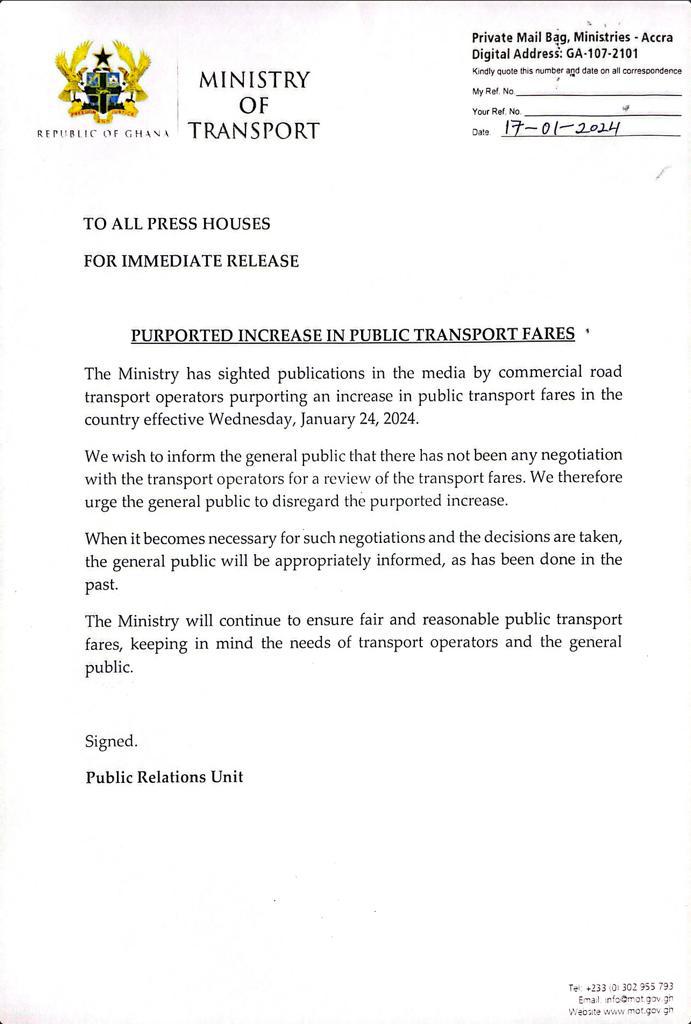
The GPRTU, working in consultation with the Ministry of Transport and other stakeholders, periodically reviews and agrees on fare adjustments. In recent months, reductions in fuel prices led the sector ministry to direct a downward adjustment in fares, which the GPRTU implemented. This reflects an existing framework for regulatory engagement, even if enforcement remains inconsistent on the ground.
The emerging crisis in Accra, Kumasi and other commercial cities
Since the later part of last year, Accra and Kumasi in particular have experienced a noticeable decline in the availability of Trotro buses for intra-city services. While precise data on fleet withdrawal is limited, the effects are visible and measurable. Terminals are overcrowded, waiting times have increased markedly, and peak-hour congestion has intensified. This scarcity has created conditions for opportunistic behaviour. Some drivers of the limited available vehicles charge unapproved and inflated fares, exploiting the imbalance between supply and demand. For commuters, the experience has become financially burdensome and psychologically draining.
In response, political actors have deployed free buses as temporary relief measures. While these interventions provide short-term respite, they are inherently reactive. They neither restore fleet capacity nor address the underlying economic and structural pressures confronting operators.
Budgetary tensions and the role of the state
At a recent engagement involving the Vice President of the republic, the Minister for Transport and senior ministry officials, GPRTU leadership argued that government budgetary allocations consistently favour state-owned transport companies while neglecting private operators who move the majority of passengers.
Their argument is not a call for government to subsidise private profits, but a critique of a public transport policy framework that does not reflect the actual distribution of service delivery responsibilities. Opposing views maintain that public funds should not underwrite private transport operations. From this perspective, the state’s responsibility should be limited to providing enabling infrastructure such as roads, terminals, traffic management systems, and regulatory oversight.
Both positions contain valid concerns. However, framing the issue as a binary choice between public funding and private operation obscures the central policy question: how should the state support the delivery of a public good when that good is predominantly supplied by private actors?
Lessons from global best practice
International experience demonstrates that effective urban transport systems are built on pragmatism rather than ideology. In cities such as London, Singapore, Bogotá, and Seoul, governments explicitly recognise mass transport as a public service, irrespective of vehicle ownership. In London, private bus operators provide services under contracts awarded and managed by Transport for London. Routes, fares, and service standards are centrally planned, while operators are remunerated based on kilometres operated and performance indicators rather than passenger volumes. This structure prioritises reliability, safety, and network integration.
Bogotá’s TransMilenio system integrates private operators into a publicly planned Bus Rapid Transit framework. Government investment focused on infrastructure and terminals, while private firms procured and operated buses under long-term concession agreements. Revenue collection is centralised, reducing leakages and fare disputes. Singapore combines targeted public support with strict performance benchmarks, fleet renewal requirements, and transparent governance structures. Subsidies are conditional, time-bound, and explicitly linked to service outcomes.
The common thread across these models is clear. Governments plan, regulate, and co-invest. Private operators deliver services under enforceable contracts. Accountability, rather than ownership, is the organising principle.
Diagnosing Ghana’s core challenge
Ghana’s transport problem is not fundamentally about fares or fuel prices. It is an institutional problem. Transport is treated simultaneously as a commercial activity, a social service, and a political intervention tool, without a clear hierarchy of objectives. State-owned operators are under-resourced and inefficient. Private operators are overburdened, loosely regulated, and highly exposed to cost shocks. Infrastructure provision is uneven, while enforcement of standards is inconsistent. The result is a fragmented system in which no actor is fully empowered and no actor is fully accountable.
Practical and policy-ready solutions
First, Ghana requires a coherent national urban transport policy that formally recognises private operators as partners in delivering public mobility. High-demand corridors should progressively transition to contract-based service provision with clearly defined performance standards.
Second, government investment should prioritise infrastructure that directly lowers operating costs. Modern terminals, dedicated bus lanes, traffic signal prioritisation, and route rationalisation can significantly improve efficiency without directly subsidising day-to-day operations.
Third, fleet renewal must be addressed through structured financing mechanisms. Government-backed credit guarantees and low-interest loan schemes, tied to vehicle standards and maintenance compliance, are more sustainable and fiscally responsible than direct cash transfers.
Fourth, fare regulation must be matched with credible enforcement. Charging unapproved fares should attract predictable and enforceable penalties, implemented through collaboration between transport unions, metropolitan assemblies, and law enforcement agencies. Fifth, data-driven planning is essential. Passenger volumes, peak-hour demand, and route performance should guide fleet deployment and service frequency. Digital ticketing and vehicle tracking systems can improve transparency and planning accuracy.
Finally, governance reform within state-owned transport companies is unavoidable. Persistent losses, weak oversight, and recurring corruption concerns undermine public confidence and render additional funding politically and fiscally untenable. Reform, not repetition, must be the guiding principle. Ad hoc fixes and political symbolism will not move millions of commuters efficiently each day. Only structured collaboration between the state and private operators, grounded in global best practice and local realities, will deliver sustainable outcomes. Transport is too critical to be managed reactively. It demands deliberate planning, intelligent financing, and professional governance.
>>>the writer has strong expertise in Public Relations and International Affairs across government, corporate, and non-profit sectors. He is skilled in developing communication strategies that strengthen reputation, build trust and shape policy and experienced in managing PR initiatives with proven ability to align them with organizational goals. He holds an MPhil in Strategic Public Relations Management, an MA in International Affairs, a BA and Diploma in Communication Studies, and a Training Certificate in Information Technology. His professional experience includes roles as a Research Assistant at Parliament of Ghana, Administrative Assistant with PR duties at Ho Technical University, and Senior High School English Language and ICT teacher. His research interests focus on standards, ethics, transparency, and accountability in Public Relations practice, and issues at the intersection of public policy, governance and strategic communication. He can be reached via [email protected] and or www.linkedin.com/in/edwinsarkoge
The post Public good, private wheels: Rethinking transport delivery appeared first on The Business & Financial Times.
Read Full Story


Facebook
Twitter
Pinterest
Instagram
Google+
YouTube
LinkedIn
RSS