
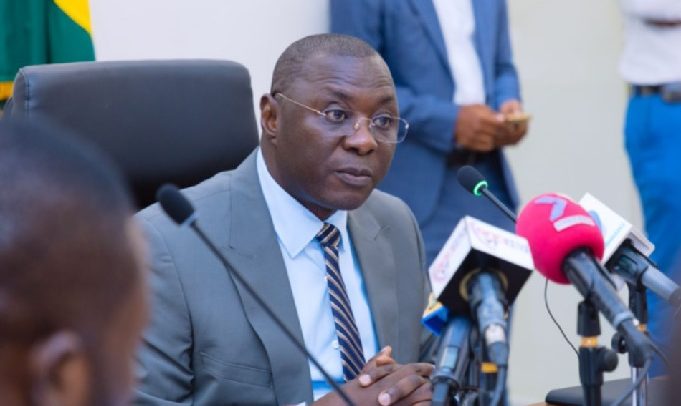

Dr. Mohammed Amin Adam
The Minority in Parliament has called on the government to immediately restore the recently reduced cocoa producer price and provide an emergency bailout to the Ghana Cocoa Board (COCOBOD), warning that failure to do so could trigger nationwide protests by farmers.
The call follows a new cocoa producer price set by the government for the remainder of the 2025/2026 crop season at GH¢41,392 per tonne (from GH¢51,660 per tonne) and GH¢2,587 per 64-kilogram bag (from GH¢3,625 per 64-kilogram bag), explaining that the revised rate is intended to align domestic pricing with prevailing global market conditions.
Addressing a press conference in Parliament yesterday, Dr. Mohammed Amin Adam, Ranking Member on the Finance Committee and immediate past Finance Minister, accused the government of mismanaging the cocoa sector and “short-changing” farmers under the guise of restructuring.
According to him, the challenges currently confronting COCOBOD stem from the government’s failure to implement a comprehensive turnaround strategy developed by the previous administration in consultation with the International Monetary Fund (IMF).
“Before we left office, we introduced a turnaround strategy for COCOBOD, and we worked on this with the IMF. It was intended to comprehensively restructure COCOBOD,” Dr. Amin Adam said.
He added, “If they had implemented the strategy we handed over, COCOBOD would not be in this mess.”
He argued that measures recently announced by the government, including the decision to move cocoa road financing to the Ministry of Roads and Highways, were already captured in the strategy but had not been implemented until the sector plunged into crisis.
The former Finance Minister also criticised the government for failing to legislate a transparent cocoa pricing policy, streamline cost items that reduce the producer price, and move COCOBOD away from non-core businesses to improve efficiency.
Dr. Amin Adam expressed surprise that the IMF had not pushed for the implementation of the agreed reforms, describing the Fund as “sleeping over” a key programme requirement.
Instead of reducing the producer price, he said, the government should have bailed out COCOBOD as the previous New Patriotic Party (NPP) administration did during price shocks.
“A better-managed economy cannot fail to pay cocoa farmers. If the economy is strong and resilient as they claim, why reduce the producer price?” he asked.
The Ranking Member on the Economy and Development Committee, Kojo Oppong Nkrumah, described the government’s directive for COCOBOD to pay farmers as ineffective, arguing that the problem was liquidity, not unwillingness to pay.
“An announcement that COCOBOD should pay farmers presumes the money is available and they were refusing to pay. What the government should be doing is releasing emergency liquidity support,” he said.
Mr. Oppong Nkrumah identified two main causes of the crisis and mentioned what he called a flawed reset of COCOBOD’s trading model and the artificial overvaluation of the cedi through heavy forex interventions.
He explained that under the previous model, about 70 percent of cocoa was sold through forward contracts and 30 percent on the spot market.
However, the new managers reversed the ratio, increasing spot sales exposure. With international prices dipping, COCOBOD is now struggling to honour higher producer prices previously announced.
“This 28 percent reduction amounts to a haircut on close to one million cocoa farmers,” he said, warning that when dependents and farmhands are considered, up to four million Ghanaians could be affected.
The Minority also linked the cocoa crisis to exchange rate policy, arguing that excessive dollar injections, reportedly about $10 billion last year, have overvalued the cedi and eroded export competitiveness.
“When your inflation is 3.8 percent, your currency should depreciate to protect exports. Instead, they are bragging about appreciation. That is poor economics,” Dr. Amin Adam stated.
He warned that an overvalued currency promotes imports at the expense of local production, citing examples of imported rice and maize competing with locally produced goods. According to him, farmers in his constituency are struggling to sell maize due to import pressures.
Dr. Isaac Opoku, Ranking Member on the Food, Agriculture and Cocoa Affairs Committee, described the price reduction, from GH¢3,625 to about GH¢2,587 per 64kg bag, as unprecedented.
“This has never happened in the history of this country,” he said, recalling that key National Democratic Congress (NDC) figures had promised before the 2024 elections to pay at least GH¢6,000 per bag.
He questioned why cocoa farmers, who he said had never received the full benefit of the Free-On-Board (FOB) price, should bear the brunt of economic adjustments.
“If cocoa farmers’ income can be slashed by nearly 30 percent, then everybody’s pay in this country should also be reduced by that margin,” he argued.
The Minority is demanding that the government restore at least the GH¢3,625 producer price, absorb the financial shock, and consider leadership changes at COCOBOD, including relieving the current Chief Executive of his duties.
They further warned that cocoa farmers are already signalling possible demonstrations over the price cut, and pledged to support any such action.
By Ernest Kofi Adu, Parliament House
Read Full Story






Facebook
Twitter
Pinterest
Instagram
Google+
YouTube
LinkedIn
RSS