
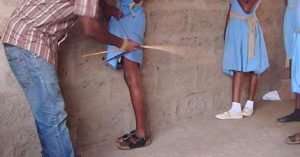

The Ghana National Education Campaign Coalition (GNECC), has hailed the Ghana Education Service’s ban on corporal punishments in primary and secondary schools nationwide.
GNECC in a statement argued that the abuse of caning constitutes an inhumane act which affects the physical and mental wellbeing of children.
“This is firmly established by studies that have confirmed that the existence of corporal punishment in schools creates a sense of naivety and fear in students, leading to lack of interest in learning. It also affects school attendance by pupils and students,” the statement signed by Chairman of GNECC, Kofi Asare added.
The Ghana Education Service (GES) in a press release on January 18, 2018, reiterated its ban on caning in primary and secondary schools.
The GES in a statement signed by the Deputy Director General, Anthony Boateng, ordered all schools to immediately adopt a new disciplinary toolkit together with alternative sanctions as measures for correcting pupils and students in schools.“This is in view of the Positive Discipline Toolkit containing positive and constructive alternatives to correcting children was developed in 2016 as a component of the Safe Schools Resource Pack.”
The tool indicated that “apart from the physical pain corporal punishment inflicts on children, this approach also causes significant emotional damage. Some of the lasting effects of this method of disciplining school children include physical scars, emotional scars (trauma, fear, timidity etc.) and violent behaviour.”
But the GES statement generated mixed reactions amongst the populace.
According to Rt. Rev. Samuel K. Osabutey, Diocesan Bishop of Accra, Methodist Church, Ghana, the country risks a total breakdown of discipline in schools and within the larger Ghanaian society, if the GES continues to relax caning, otherwise known as corporal punishment in schools.
Speaking to Citi News after an induction service for Mrs. Monica Ansaba Kumahor as the new Greater Accra Regional Manager of Methodist Schools at the Ebenezer Methodist Church, Lashibi, Rt. Rev. Samuel Osabutey said placing a total ban on caning will be counterproductive, and will have dire consequences on general discipline among students.
“Change for the sake of change does not do anybody any good. I don’t think that in those days when the people were being caned, they were being abused; because there were rules and regulations within which people had to be caned; and the GES must be careful and not just give a blanket instruction.”
But GNECC in its statement said corporal punishment breaches Section 13 [1] of the Children’s Act, 1998 [Act 560] which states that : “No person shall subject a child to torture or other cruel, inhumane or degrading treatment or punishment including any cultural practice which dehumanises or is injurious to the physical and mental well-being of a child.”
“We encourage teachers to use the GES approved toolbox for instilling discipline in schools to make the school environment enjoyable and not fearsome to students. We hope this allows students to freely express themselves in class, especially in subject areas where they lack adequate proficiency, as a means of encouraging learning.”
The coalition also urged the Ghana Education Service to “sanction any teacher who flouts this directive.”
–
By: Godwin Akweiteh Allotey | citinewsroom.com | [email protected] | Ghana
Follow @AlloteyGodwin
The post Sanction teachers who flout ban on caning – GNECC to GES appeared first on Citi Newsroom.
Read Full Story







Facebook
Twitter
Pinterest
Instagram
Google+
YouTube
LinkedIn
RSS