general news
Supreme Court dismisses former GHAPOHA workers’ case
The Supreme Court Wednesday dashed the hopes of more than 4,000 former casual workers of the Ghana Ports and Harbours Authority (GHAPOHA) of getting extra compensation for a redundancy exercise carried out by the authority in 2002.
The court, by a unanimous decision, dismissed the case on the grounds that the legal team of the retrenched casual workers failed to, among other things, do due diligence on the case.
It, therefore, upheld a 2007 Court of Appeal ruling which declined to affirm a Tema High Court decision that ordered GHAPOHA to pay severance awards to its former casual employees.
Court speaks
Reading the judgement on behalf of the five-member panel, presided over by Mrs Justice Georgina Wood, the Chief Justice, Mrs Justice Rose Comfort Owusu, described the decision as a painful loss for the workers.
“I say ‘painfully’ because it is not that the appellants did not have a case to pursue but they have lost because their case was not well-handled with due diligence,†she said.
The stunned former casual workers watched in disbelief as their case, which had travelled through the legal mill for the past 11 years, crumbled before the highest court of the land. Â
Making reference to a legal precedent, the court said, “In undertaking their clients’ business, legal practitioners guaranteed the existence and due employment of skill and diligence on their part.â€
“Regrettably, the appellants who have been treated so unfairly by the respondent authority leave here without any redress and their plight rather worsened off,†it said.
Among other things, the court had issues with the inability of counsel for the respondents to amend the list of plaintiffs in the writ, even though the High Court had granted him leave to do so and also that the plaintiff’s counsel did not take advantage of negotiations when he was faced with statute of limitation challenges.
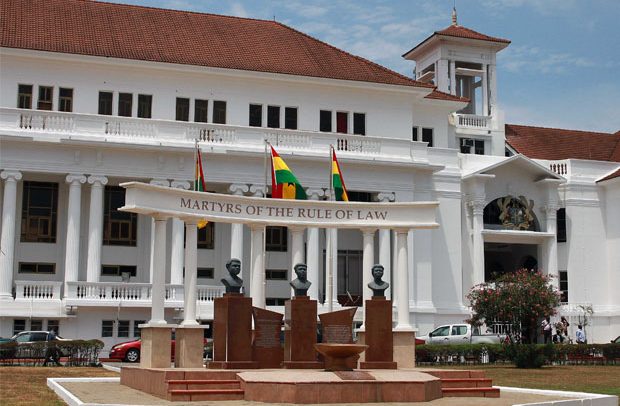
More than an hour after the court had pronounced its judgement, the bewildered casual workers stood in front of the Supreme Court building discussing the outcome of the case.
Others with their faces buried in their palms, as if to hide their pain and tears, leaned on the Supreme Court building, most probably as the implication of the loss of the case began to dawn on them.
Facts of  the case     Â
On July 11, 2003, the retrenched workers filed a suit at the High Court against GHAPOHA, seeking damages for breaching the provisions of their collective bargaining agreement (CBA), and asked the court to award compensation for maintaining them as casual workers in violation of their economic rights under the Constitution.
They also sought an order that compensation packages payable for severance of permanent employees be paid to them and interest on all sums found due and owing them at the bank rate from October 1, 2002 to the date of judgement.
The court, on January 18, 2006, entered judgement in favour of the ex-workers.
It ordered GHAPOHA to pay ¢5 million to each ex-worker for breach of the collective bargaining agreement and ¢10 million to each for each year of service “after the expiration of 154 continuous working days†for keeping them as casual workers.
Furthermore, the court ordered the authority to pay severance awards comprising three months’ salary for each year of service, ¢3 million in lieu of rent, ¢2 million as medicals, two bags of rice, two gallons of oil, ¢1.5 million conveyance fees, bonus for 2001, five months’ salary as handshake, interest from October 2001 and ¢10 million as costs.
GHAPOHA’s appeal
GHAPOHA appealed against the court’s decision on the grounds that the trial judge gave judgement for 3,839 workers plus a further 356 plaintiffs as if they were parties to the action, although the record of proceedings and relevant rules of the court established that they were not.
It argued that the trial judge’s finding that the authority acted illegally and unlawfully in treating the ex-workers as non-permanent employees was erroneous, since there was no evidence on record of the period of employment of each plaintiff, adding, “There is no evidence that any of the plaintiffs had worked satisfactorily for 154 days in any year to qualify for upgrading as permanent employees or to warrant the finding of the trial judge that GHAPOHA breached the collective bargaining agreement.â€
Giving a background to the case, Justice Owusu said at the High Court, “the writ of summons had five persons named and others in quote as plaintiffs.  The writ was accompanied by an addendum filed on the same day which stated that a full and a comprehensive detailed list of all the plaintiffs would be submitted subsequentlyâ€.
The plaintiffs later filed the list of persons of about 3,839, the trial proceeded to its conclusion and the High Court entered judgement for the named plaintiffs and the others who were listed in the addendum. Â In the course of the proceedings, an application was filed to amend the writ to add 356 more people as plaintiffs.
“Even though the application was granted by the High Court, with an order that the title of the writ be amended to include the 356 employees as plaintiffs, the order was never complied with, but the trial proceeded to conclusion and judgement entered in favour of the named plaintiffs and the others purported to be plaintiffs, as well as the 356 others who were to be joined following the leave granted for them to join the case, which was never carried out,†she said.
Appeal court
However, when the case went to the Court of Appeal, GHAPOHA had argued that the trial judge erred by giving judgement in favour of the 3,839 and the 356 employees as plaintiffs in the action.
GHAPOHA had maintained that the list of persons filed by the plaintiff after issuing the writ did not represent the plaintiffs called at the trial.
Further, the 356, GHAPOHA insisted, could not be recognised as plaintiffs, as no steps were taken to implement the order of the High Court to join them as parties to the action, pursuant to the grant of application for joinder.
GHAPOHA canvassed the same argument at the Supreme Court.
The case travelled to the Court of Appeal where, on April 20, 2007, the court declined to endorse the High Court’s ruling.
Writer's email: [email protected]










Facebook
Twitter
Pinterest
Instagram
Google+
YouTube
LinkedIn
RSS