


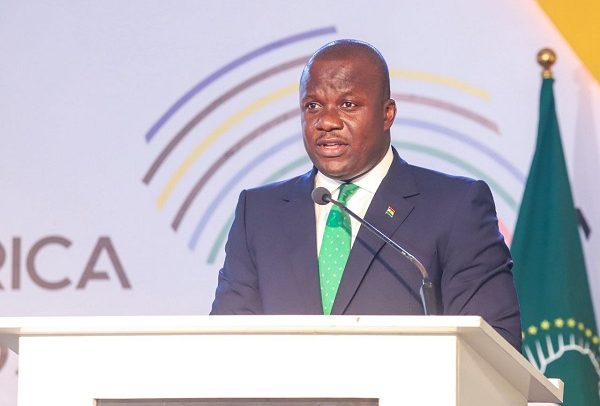
The Chairman of Parliament’s Subsidiary Legislation Committee, Patrick Boamah, has warned that the proposed sliding?scale royalties regime under the Minerals and Mining Royalties (Regulations) 2025 could harm Ghana’s economy by discouraging investment, triggering job losses and weakening the country’s competitiveness in the global mining sector.
Interacting with journalists on the regulations on Tuesday, March 10, 2026, Patrick Boamah said although the Committee had completed its mandatory scrutiny of the instrument, serious concerns remain about the broader economic consequences of the new royalties framework.
According to him, while government maintains that Ghana is “open for business,” current fiscal decisions within the mining sector send a contradictory signal to both local and international investors.
“We critically examined the policy and its effects on the mining sector. But there are still strong reservations about how this regime will affect investments and the overall sustainability of mining operations in the country,” Patrick Boamah said.
The regulations laid in Parliament on December 19, 2025 mature on March 10, 2026 after the constitutionally required 21 sitting days. However, the Chairman of Parliament’s Subsidiary Legislation Committee stressed that maturity of the instrument does not erase the economic risks associated with the policy.
Investor confidence at risk
Patrick Boamah disclosed that an Ernst & Young report, commissioned by stakeholders in the mining industry, paints a troubling picture of the sector’s future under the current royalties and fiscal regime. The report reportedly highlights anticipated job losses, declining capital inflows, and reduced investor confidence if the sliding?scale royalties are implemented without accompanying relief measures.
He noted that Ghana currently ranks among the least attractive mining jurisdictions globally, largely due to its high fiscal burden on mining companies. “When you look at the royalties regime and the broader fiscal framework in the mining sector, Ghana ranks number one in terms of burden,” he said adding, “what all this tells investors is that Ghana is no longer attractive.”
A major source of frustration for industry players, the Chairman of Parliament’s Subsidiary Legislation Committee said it is the government’s failure to honour a promise to reduce the Growth and Stabilisation Levy from 3 percent to 1 percent.
According to him, the Ministry of Finance had assured the mining community that the reduction would be implemented to cushion the impact of the new royalties structure.
However, no such proposal has been presented to Parliament.
“As we speak, that hasn’t happened. This tells you that government has not been honest with the mining community, and that is why this Ernst & Young report was commissioned.”
He warned that multinational mining companies, which operate in several jurisdictions, regularly report policy risks to their headquarters, and Ghana’s credibility is at stake.
“These are global companies. Their reports go back to their head offices, and if we are not seen as consistent or credible, they will simply look elsewhere,” he added.
Declining global rankings
Patrick Boamah further cited global mining indices to support his concerns, noting that Ghana’s position has worsened in recent years.
In the Fraser Institute’s Investment Attractiveness Index, Ghana fell from 46th out of 82 countries in 2024 to 53rd out of 68 countries in 2025.
Similarly, in the Global Mining Perception Index, Ghana dropped from 46th in 2024 to 60th in 2025.
The Global Best Practices Index also shows Ghana near the bottom of global rankings, an indication, Patrick Boamah said, that mining capital is increasingly being redirected to countries such as Peru, Colombia, South Africa, Côte d’Ivoire and Mali.
Beyond investment flows, he warned that the sliding?scale royalties could result in massive job losses, undermining government revenue in the long term.
He said Ghana expects about US$7 billion in mining investments between the past five years and 2028, investments that would support local businesses, local content initiatives, and employment.
“If you introduce this sliding scale, you may gain some revenue in the short term,” he cautioned, adding “but the net effect could be job losses close to a million.”
According to him, losing such a large number of jobs would reduce income tax receipts, corporate taxes, and economic expansion, ultimately defeating the purpose of the higher royalties.
Local ownership under threat
The Chairman of Parliament’s Subsidiary Legislation Committee also expressed concern about government’s plan to encourage Ghanaian ownership of mining assets, especially as some major leases are due to expire by the end of the year.
While welcoming local participation, he argued that Ghanaian investors cannot succeed without a supportive fiscal and regulatory environment.
“If a Ghanaian takes over a mining investment and cannot raise the required capital because the fiscal regime is too harsh, that investment will not thrive,” he said.
He stressed that local ownership should be supported through incentives that promote capital retention, job creation, and currency stability, rather than policies that strain operations.
Patrick Boamah concluded by urging government to realign its mining policies with its stated economic objectives.
“You cannot, in one breath, increase royalties through a sliding scale and, in another breath, take away the support required for investors to survive. That is a contradiction that must be addressed,” he said.
He called on government to urgently review the royalties regime, honour its commitment on the Growth and Stabilisation Levy and adopt a balanced framework that attracts investment while safeguarding national revenue and employment.
By Stephen Larbi
For more news, join The Chronicle Newspaper channel on WhatsApp: https://whatsapp.com/channel/0029VbBSs55E50UqNPvSOm2z
The post Mining Sliding?Scale Royalties Will Hurt Ghanaian Economy –Patrick Boamah appeared first on The Ghanaian Chronicle.
Read Full Story


Facebook
Twitter
Pinterest
Instagram
Google+
YouTube
LinkedIn
RSS