


Ghana’s infrastructure drive has gathered real momentum in recent years. Large national projects continue to shape public discussion, especially after the presentation of the 2026 Budget by the Minister of Finance. One of the most debated proposals is the Accra–Kumasi Expressway.
The reactions have been mixed, but what is clear is that Ghanaians are thinking seriously about how the country should grow and how mobility can support that growth. The level of engagement shows that the public is ready for solutions that make life easier and expand economic opportunities.
At the same time, the National Development Planning Commission is refining the Ghana Infrastructure Plan, which sets out how the country intends to develop over the long term. Among its proposals is an underground railway running from Accra to Adenta.
It is intended to ease congestion along the Liberation Road and Independence Avenue corridor and to improve access to Airport City and Kotoka International Airport. The idea recognises a genuine need. Accra requires an efficient mass transit system. But the technology we choose will determine the success or failure of such a project. The realities on the ground suggest that an underground system may not be the most practical or cost-effective choice. A sky train presents a better option that suits Accra’s terrain, climate and financial capacity.
Lessons from Earlier Sky Train Attempts
When Ghanaians hear the term sky train, many remember earlier attempts to introduce an elevated urban rail system. Those attempts were widely discussed and eventually became the subject of legal proceedings involving some former government officials. Although these matters created understandable public hesitation, they should not erase the value of the idea itself. The concept was not the problem. The challenge was how it was handled.
All major infrastructure requires proper planning, transparent procurement and credible feasibility studies. If these steps are followed, there is no reason Ghana cannot successfully implement a sky train system like many other countries. If preliminary studies from the previous attempt already exist, these can still be useful. Updated, corrected and reviewed carefully, they can help Ghana avoid old mistakes and progress more quickly.
Challenges with an Underground System for Accra
The underground proposal must be examined in view of Accra’s physical and financial conditions. Around the world, underground railway systems are among the most expensive forms of public transport infrastructure. Cities like London, New York and Cairo spend enormous sums on construction, not only because of the tunnels but also because of the complex safety systems needed below ground. Cairo’s metro, one of the few in Africa, demands constant and heavy investment to remain safe and functional.
Accra faces major flooding challenges year after year. Many parts of the city sit in low-lying areas and the drainage network is still developing. Tunnelling under such terrain introduces high engineering risks. Water seepage, soil instability and the threat of flooding create safety concerns that can only be addressed through costly and continuous maintenance. Ghana would need to commit large resources to ensure the system remains safe in a city that is still working to overcome flood-related challenges.
Time is also an important factor. Underground systems typically take a decade or more to complete. Progress can be slow because contractors must navigate existing utilities, crowded settlements and unpredictable soil conditions. In Accra, with its heavy traffic and dense commercial activity, the disruptions caused by years of excavation would be significant. Communities and businesses would face prolonged inconvenience. After all the cost and disruption, the system may not deliver the level of value Ghana needs.
A More Practical Alternative
A sky train offers a more practical and achievable solution. Elevated rail lines can be constructed above existing roads, which limits the need for land acquisition and reduces the risk of displacing people and businesses. With no deep excavation involved, construction is much faster, more predictable and far less disruptive. The system is naturally protected from flooding since it operates above ground. This gives it a major advantage in a city that is still battling seasonal floods.
Across the world, cities have embraced elevated rail systems because of these advantages. Bangkok, São Paulo, Jakarta and Cairo have all transformed mobility through elevated lines. These systems move large numbers of people quickly and reliably. They also help shape the urban landscape and encourage organised development along the rail corridors. Accra, which is expanding rapidly, can benefit from the same approach. A sky train can become both a functional transport system and a defining feature of a modernising city.
Financing a Realistic Option
Africa is beginning to see more examples of mass transit systems delivered through public-private partnerships. South Africa’s Gautrain and the Lagos Blue Line in Nigeria provide useful lessons. Investors are generally more willing to finance elevated rail systems because the construction risks are lower and the cost estimates are more predictable. Ridership and revenue projections are also easier to model.
Ghana can take advantage of these factors. With a clear regulatory framework, transparent processes and credible feasibility studies, a sky train can attract private investment. If earlier feasibility work exists from the previous project discussions, those findings can be updated and improved. This would reduce the time needed to restart planning and help ensure that Ghana enters the next phase with better preparation.
The Need for Forward Planning
The expectation is not for the current administration to complete an entire sky train network within a single political term. Large transport systems evolve over time and across governments. What matters now is laying a strong foundation. This includes commissioning updated feasibility studies, identifying the most beneficial routes, setting technical and safety standards, and designing a financing model that will attract serious partners.
Once this foundation is laid, construction can proceed in phases. Even a first phase covering one or two key corridors would make a visible difference in travel times and congestion. Each completed section would reduce pressure on the road network and show the public that progress is being made.
Accra’s traffic burden increases every year. Simply expanding roads cannot keep up with the growth in population and vehicle numbers. Without a modern mass transit system, the city risks choking its own economic potential. The longer Ghana waits to make a decision, the more difficult and expensive the problem becomes.
The Time to Decide Is Now
The underground proposal is ambitious, but ambition must be balanced with practicality. High costs, technical risks, flooding concerns and long construction timelines make it a challenging option for Ghana today. A sky train is a more realistic and forward-looking solution. It fits Accra’s environment, aligns with Ghana’s economic capacity and can be delivered within a reasonable timeframe.
The NDPC, working with the government, has an opportunity to champion a system that will shape Accra for generations. The decisions taken today will influence the city’s character long into the future. This is the moment to embrace a new direction in urban mobility and give Accra the modern transport system it deserves.
By Dr Joseph K. Ofori-Kuragu
The Author is a PPP expert based at Anglia Ruskin University, UK. He is a Director at Innovation Inc (www.innovationinc.group) and can be reached at: [email protected]
The post Feature: Now, Let’s Build a Sky Train for Accra appeared first on The Ghanaian Chronicle.
Read Full Story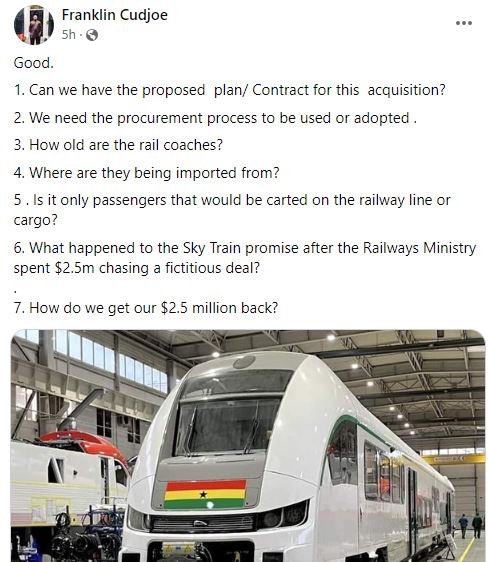







Facebook
Twitter
Pinterest
Instagram
Google+
YouTube
LinkedIn
RSS