


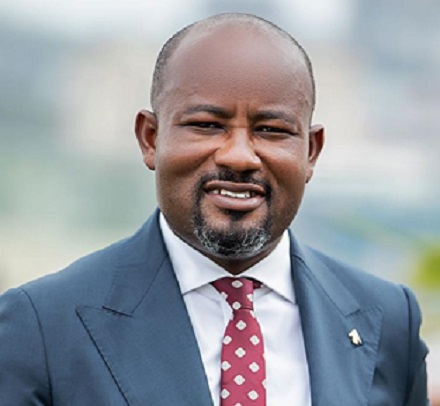
The Minister of Communications, Digital Technology and Innovations, Samuel Dzata George, on Wednesday, December 3, 2025, granted an exclusive interview to TV3 about his ten months of stewardship. The interview touched on a number of industry issues such as network quality of services, the DSTV saga, the upcoming SIM registration, the 15 new industry legislations in the pipeline and also the sensitive issue of what government intends to do with the embattled AT Ghana.
Conspicuously missing in that interview though, were two of the hottest industry issues since Sam George became minister – the AT Ghana-Telecel “merger or absorption”, and the end of year deadline for the rollout of 5G in Ghana. One cannot confirm whether the interview was intentionally designed to avoid those two sensitive topics, or it was just the interviewer who forgot to ask about those.
Interestingly, the interviewer, Rowland Walker, delved a bit into the AT Ghana issue, but stopped short of asking about AT’s merger with or absorption by Telecel, which the minister started to champion strongly earlier in the year. The last time the minister spoke about that matter, he told us Telecel is currently providing roaming services to AT, while KPMG does an audit to then advise government on what the relationship between the two entities, and the terms of it should be like. Meanwhile ahead of telling us about the KPMG audit, he had already been reported on the Ministry’s own LinkedIn page as telling staff of AT Ghana at a durbar that the two companies were being MERGED and that the MERGER was about 90% complete. He even gave three levels of integration and some timelines, before later he backtracked and said government was waiting for KPMG to advise.
Even though the minister announced back in September that KPMG had been contracted as transaction advisors, Techfocus24 learnt that not until around mid-October that KPMG actually got instructions to start work on this matter. Now, in the TV3 interview, the Minister said KPMG’s mandate is to audit AT Ghana before government could decide what to do with it – whether to invest in it or not. He even said he had proposed an audit of Telecel Ghana too. He NEVER said anything about the AT-Telecel merger/absorption or whatever it is.
Blaming AT management
During his submission on the AT matter, the minister made one statement that threw everybody off, particularly the hardworking and highly respected AT workers, who have a reputation in the industry as being some of the best in the space. In fact, for the several years this writer has been covering this industry, it has always been a common narrative and an industry by word that Tigo and by extension AirtelTigo (now AT Ghana) has some of the best brains in the industry. The point had always been made that if only they had the kind of investment/money that MTN has at its disposal, they will do magic in this country. Even people who work for other telcos know and say this all the time.
But the minister, for the first time in all his comments about this matter, decided to take a swipe at the management of AT Ghana and blame them squarely for the current state of the company.
Here is what he said:
“The very people who run Airtel to the ground [and] run Millicom to the ground are sitting in management today at AT and have run it to the ground. This government must not put fresh money into the company without auditing what the management of the company has done.”
Prior to this new comment, the Minister had always suggested that lack of investment is the root cause of AT Ghana’s woes. At the durbar with the workers, where he first announced the merger, he did say that lack of investment was the main issue, so every step government is taking was to ensure that the company is positioned to attract investors. But he also made it clear that NO JOB WILL BE LOST at AT in whatever arrangement is arrived at. The jobs at AT include the current management, who are handicapped because the previous shareholders (Bharti Airtel and Millicom) and the current sole owner (Government) have all failed to invest.
But for some reason, the minister has decided to include the management, and by extension the workers in his bashing narrative. Formerly, he used to attack the previous government’s policy failures, and the shareholders failure to invest. But now the management is also on the chopping.
Tigo and Airtel management roll call
From the minister’s own comment, you would notice that the woes of Tigo and Airtel did start from the days of AirtelTigo. In fact, the two companies merged because they were each having grave problems borne out of lack of investment and never due to poor management. Honest people at the National Communication Authority (NCA) would admit that they saw the signs of the downward trend due to lack of investment several years ago, and they knew it had little to do with the quality of the companies’ management teams.
Let’s do a bit of a roll call on who has been on Tigo and Airtel management over the years, and where they are now, so you know the problems of the AT could never have been management.
- Patricia Obo-Nai – worked in management at Tigo for 14 years. Now she is the CEO of Telecel Ghana
- Lucy Quist – worked in Tigo and Vodafone Ghana management for several years, became CEO of Airtel Ghana, later CEO of Morgan Stampley
- Mitwa Ng’ambi – was CEO of Tigo Ghana and was poached by MTN to become CEO of MTN Rwanda. Now she is CEO of MTN Cameroun
There were several others like Obafemi Banigbe, one of the smartest CTO’s this country has even seen. He was the CTO of Tigo Ghana. Tara Squire, Jesse Agyepong, Gifty Bingley and several others who worked in Commercial, Marketing and Communications at Tigo, Airtel and Telecel at different times. All these people had to walk away and look for better opportunities because lack of investment became stifling for them. But they were some of the best brains in the industry. Where they are today is testimony to their brilliance; and yet Airtel and Tigo started falling under them.
Workers demoralized
This attack on management by the minister is said to have caused grave concerns for the workers who are already demoralization by what seem to be politicians playing chess with their future. The workers had earlier attempted to hold either a press conference or an outdoor demonstration to demand for clarity about the future of the company and of their own security. But the very management that the minister is blaming now, advised the workers against it, so they rather chose a peaceful protest by going to work in red and black to indicate that they are in a state of mourning and confusion because there is no clear policy direction from the only shareholder, the government on the future of the company after ten months.
The other thing worrying about the minister’s comment is that, he announced that an auditor (KPMG) has been appointed to look into the issues and advise government on what to do. Moreover, he has also presented a proposal to Cabinet, seeking direction on what to do with AT Ghana. While the audit report is not ready and Cabinet is yet to give its direction, the minister is already pontificating, blaming the woes of the company on what he called “management staff”. This sounds similar to how he announced a merger between AT and Telecel before backtracking and saying that KPMG was yet to do an audit and advise government.
$250 million debt, Force Majeure and related matters
One of the minister’s key narratives about this AT Ghana issue is that the company has a debt of $250 million and that has now become a liability for government, since the previous government paid $1 for the full assets and liabilities of AT Ghana. The staff and management, as well as industry experts have always questioned the rationality and truth of that statement for a number of reasons;
AT Ghana is run by PPL Net, which is owned by Airtel Ghana, which is also owned by government. What the previous government did was to put all the assets and staff of AT Ghana in PPL Net, and leave the liabilities for Airtel Ghana. So the debt owed to creditors still sits with Airtel Ghana, while PPL Net started as a completely debt free company. Now the minister claims PPL Net has also piled up a $15 million debt, and is losing up to GH¢22 million every month. But the truth still remains that PPL Net, which now runs AT Ghana, does not have a $250 million debt on its books. Moreover, in an industry like telecoms, a $15 million debt is insignificant. It is not the kind of debt that will drive investors away, and that is why investors like the Rektron Group, Axian and others are showing interest in AT Ghana now. Even Telecel is excited about the prospects of merging with AT Ghana, something they dreaded initially.
Now even the $250 million debt supposedly sitting on the books of Airtel Ghana, that is true. But there is a perspective to that story, which has conveniently been kept out of the conversation arguably because that perspective will not serve a certain hidden agenda. Remember that in announcing the AT-Telecel merger, the minister stated that it was due to a FORCE MAJEURE (an act of God, or circumstances beyond human control). So, government was compelled to migrate over three million AT Ghana customers to Telecel to ensure that they did not lose network service.
What was the force majeure he referred to? Leading tower company, American Tower Corporation (ATC) Ghana disconnected some strategic towers of AT due to the latter’s long-standing indebtedness to the former. The Minister had initially put that debt at GH¢1.5 billion, but Techfocus24 gathered it was actually over GH¢2 billion (more than $200 million).
Here is what the minister did not tell us: ATC had long slashed down that debt to about $20 million. How did they do this? They first cancelled all the accumulated interest on the debt owed by AT and also slashed down the principal by about 80%. This information has long been made available not only to the minister, but also to the Presidency, Finance Ministry and even to National Security. The reason National Security was involved was because the World Bank e-Transform project was rolled out mainly on the AT Ghana network, and so shutting AT’s antennas down has also impacted that e-Transform network as well.
All this was done just to make it easier for the government to breathe and be able to come to the negotiation table with ATC, and discuss a payment plan so that ATC can continue to offer services to PPL Net and keep the customers of AT on the AT network. Moreover, following ATC gesture, Cabinet allegedly approved some money (specific amount withheld) to be invested in PPL Net so that it can at least sort out ATC to some extent and also sort out other vendors like Huawei just to keep the network going and even improved. But in the Minister’s wisdom, no investment for PPL Net until KPMG is finished with its audit. That strikes smart, until you consider the fact that the minister had long initiated steps to merge AT and Telecel even before he claimed KPMG was now being engaged to advise on the deal.
The million-dollar question is this: why was the minister so quick to tell the public about the GHS1.5 billion bill ATC presented to him as debt owed by AT Ghana from the previous administration, but he has kept the fact that ATC has since cancelled all interest and also slashed the principal down heavily, so the new debt is actually just about US$20 million? Keeping such vital information out of the conversation, particularly after spilling the beans on the original debt levels looks suspicious.
So, was a force majeure the real reason why ATC had to shut down the AT Ghana antennas or this whole thing is just a deliberate dragging of the feet on the part of the government just to serve a certain agenda? It is confusing that government sat by and still watched ATC to cut off AT Ghana, and then turned round to claim that AT’s woes is due to a force majeure, as if nothing could have been done about $20 million. In fact, the picture the government painted actually put ATC in a bad light – as if they are still holding AT to the huge GH¢1.5 billion debt Sam George claimed to have inherit from ATC alone. But the truth is that the debt has been slashed down heavily; and I am even informed there is a possibility it can go down further.
When ATC shut Telecel
About a year ago, ATC shut down some Telecel sites for a similar reason – indebtedness. The NCA, under the direction of the previous government, stepped in and ORDERED ATC to reconnect Telecel and come to the negotiation table. This was even Telecel, in which government owns only 30%. But here we have AT Ghana, which is owned entirely by government, and yet government conveniently allowed the same ATC to shut them down over indebtedness, even after ATC had showed good faith by slashing down the debt heavily.
Speaking of indebtedness, we are informed that Telecel also has a huge debt sitting on its books, which it inherited from Vodafone, plus what it added on over the last few years. They claim to have invested US$243 million cash into the network since coming to Ghana. I am informed that they have presented evidence of that investment to the NCA with a caveat not to make it public. Meanwhile, the narrative out there is that the said $243 million is mainly debt cancellation and a little cash. So, it is not all cash as Telecel would want the public to believe. But Telecel has refuted that narrative vehemently.
How did the debt cancellation come about? The Vodafone Group is said to have passed on its assets and liabilities to Telecel. That package included some millions of dollars owed to the Vodafone Group by Ghana Telecom. So, the Telecel Group decided to forgive Ghana Telecom of that debt and service it from its own coffers. So, Telecel now counts that debt cancellation as an investment into the network because it is still paying off the debt to creditors. The bottom line is that Telecel has debts on its books too, which they are still servicing. In fact, the minister was the first to even accuse them of failing to invest the $100 million they promised in year one. But now the minister is happy to migrate AT Ghana’s customers to Telecel on the back of a promise of some $50 million investment to accommodate the AT customers, when government could have gone to the negotiation table with ATC, particularly after they slashed down the debt heavily.
What has gone on so far, leaves more questions than answers in the minds of industry watchers and analysts:
Why would the minister blame the woes of AT Ghana on lack of investment, then turn round and blame it on management of AT even ahead of the auditors’ report?
Why would the Minister accuse the previous government of failing to do due diligence in the Vodafone-Telecel deal, which led to Telecel allegedly failing to bring in the $100 million cash, and yet the same minister is quick to jump to Telecel as a saviour for AT Ghana?
Why would the minister say to AT workers that his policy is to merge Telecel and AT, and then turn round and say it is neither a merger nor an acquisition but something else yet to be decided on by government based on the advice of a transaction advisor who is yet to issue a report? Meanwhile, Telecel is out there telling the world it is an absorption.
Why would the minister claim that what led to the shutdown of AT network by ATC Ghana was a force majeure when in fact ATC had bent over backwards by cancelling all interest and slashing down AT’s principal debt by about 80%?
If government could intervene in the Telecel-ATC matter last year, why couldn’t government intervene in the ATC-AT matter, particularly after ATC had slashed down the money owed them so heavily?
In choosing to migrate AT Ghana customers to Telecel, government had to turn down the opportunity of an investor bringing in some $150 million for 60% shares in AT. What were the actual reasons for turning down that offer – was it really because the investor lacked prior-experience in telecoms (as if the people at AT don’t have experience in telecom), or there were other reasons?
We leave it here.
By Samuel Dowuona
The post Are AT Ghana’s woes due to poor management or lack of investment? appeared first on Ghana Business News.
Read Full Story











Facebook
Twitter
Pinterest
Instagram
Google+
YouTube
LinkedIn
RSS