
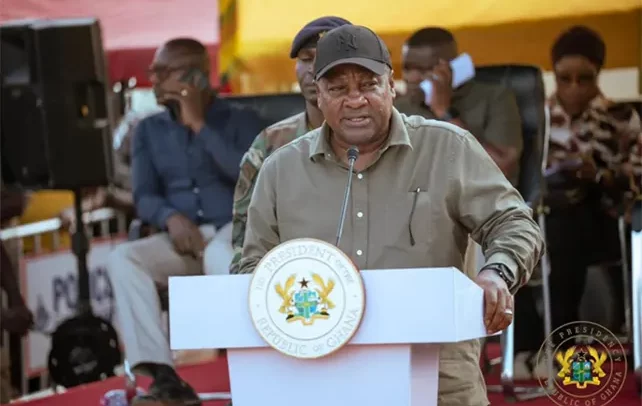

President John Dramani Mahama
President John Dramani Mahama has announced government’s plans to elevate the Ho and Hohoe Municipal Assemblies to Metropolitan status, a move aimed at strengthening local governance and accelerating urban and economic development in the Volta Region.
The President made this known during the sod-cutting ceremony for the Ho Oxygen City Affordable Housing Project, a major housing initiative being developed by the Tema Development Corporation (TDC) in partnership with government, traditional authorities and private sector stakeholders. The project, which is expected to significantly expand access to affordable housing, also forms part of a broader vision to promote planned urban growth beyond Ghana’s traditional metropolitan centres.
According to President Mahama, the decision to earmark Ho and Hohoe for metropolitan elevation is informed by their rapid population growth, expanding commercial and economic activities, and increasing strategic importance within both the Volta Region and the national development framework. He noted that the two municipalities have outgrown their current administrative status and now require stronger institutional capacity to effectively manage urbanisation pressures.
He stated that attaining metropolitan status would enhance the ability of the assemblies to plan, regulate and coordinate development more efficiently. This, he said, would translate into improved service delivery in critical areas such as housing, road infrastructure, sanitation, water supply, health, education and other social services.
“Decentralisation remains a central pillar of our governance philosophy,” President Mahama stated, and added, “By strengthening local government structures and giving them greater authority and resources, we bring development closer to the people and ensure that growth is inclusive and sustainable.”
The President further noted that metropolitan status would make Ho and Hohoe more attractive to both public and private investment, create new employment opportunities as well as stimulate accelerated infrastructure development. He emphasised that planned urban expansion, supported by affordable housing schemes such as the Oxygen City project, is essential to preventing unplanned settlements and improving overall living standards.
Ghana’s decentralisation system is anchored in the 1992 Constitution and operationalised through the Local Governance Act, 2016 (Act 936). The policy seeks to transfer political, administrative and fiscal authority from central government to Metropolitan, Municipal and District Assemblies (MMDAs), thereby promoting participatory governance and local development.
Under the decentralised system, local assemblies are responsible for development planning, budgeting, revenue mobilisation and service delivery within their jurisdictions. The system is designed to ensure that decisions affecting local communities are made at the local level, with direct input from the people.
Assemblies in Ghana are categorised based on population size, level of urbanisation and economic activity. Generally, a District Assembly serves areas with populations below 75,000. A Municipal Assembly is established for towns and cities with populations of at least 95,000 and significant urban characteristics. A Metropolitan Assembly is created for large urban centres with populations of 250,000 or more, or with special strategic and economic importance.
The creation of an assembly requires a government proposal, approval by Parliament through a Legislative Instrument, and endorsement by the President. In some cases, population thresholds may be complemented by considerations such as regional capital status, economic significance and development potential.
Ho currently serves as the Volta Regional Capital and has witnessed steady growth in population, commerce, education, health services and real estate development. Hohoe, on the other hand, has emerged as a key commercial and transit hub in the northern corridor of the region, with increasing industrial and agricultural activity.
President Mahama indicated that the processes toward metropolitan elevation would involve technical assessments, stakeholder consultations and the necessary legal and administrative steps. Once completed, the new metropolitan assemblies would have enhanced staffing, expanded departments and greater fiscal authority to manage development.
He assured residents that government would work closely with traditional authorities, opinion leaders and the general public to ensure a smooth transition and to maximise the benefits of the new status.
The planned elevation of Ho and Hohoe, coupled with major housing and infrastructure projects, signals a renewed focus on decentralisation as a tool for balanced national development. For the people of the Volta Region, the move is expected to open a new chapter of growth, opportunity and improved quality of life.
FROM Daniel K. Orlando, Ho
Read Full Story









Facebook
Twitter
Pinterest
Instagram
Google+
YouTube
LinkedIn
RSS